
BitNest Review: Is BitNest Legit or a Ponzi Scheme?
 Click to Zoom
A platform claiming to have $34 Million in liquidity appeared out of nowhere. It promises daily returns that would make Wall Street hedge funds look like amateurs. You likely received a link on WhatsApp, Telegram, or Facebook Messenger from a friend who swears they “just withdrew $50” and that the system is “paying fast.”
They call it “Web 3.0.” They call it the future of decentralized finance.
But does a platform with anonymous owners, broken English, and a neon-colored website sound like a financial miracle, or a trap designed to drain your USDT?
I have spent the last 4 hours auditing BitNest, analyzing their domain history, and inspecting their source code.
Here is the ruthless, data-driven truth about BitNest.
Quick Check
| Website | https://bitnest.me |
| Trust Score | 22/100 |
| Trustpilot Data | |
| Status | Online |
| Verdict | Suspicious Website |
| Domain Age | Private/Hidden |
| Social Profile | None detected |
| Last Checked | January 28, 2026 at 05:19 PM |
The Visual Lie Detector
Before we even look at the blockchain code, we need to look at the psychological tricks BitNest uses on its interface. A legitimate DeFi project like Uniswap, Aave, or Compound has a clean, professional, and often minimalist interface. They focus on utility.
BitNest, on the other hand, looks like a casino built in a basement.
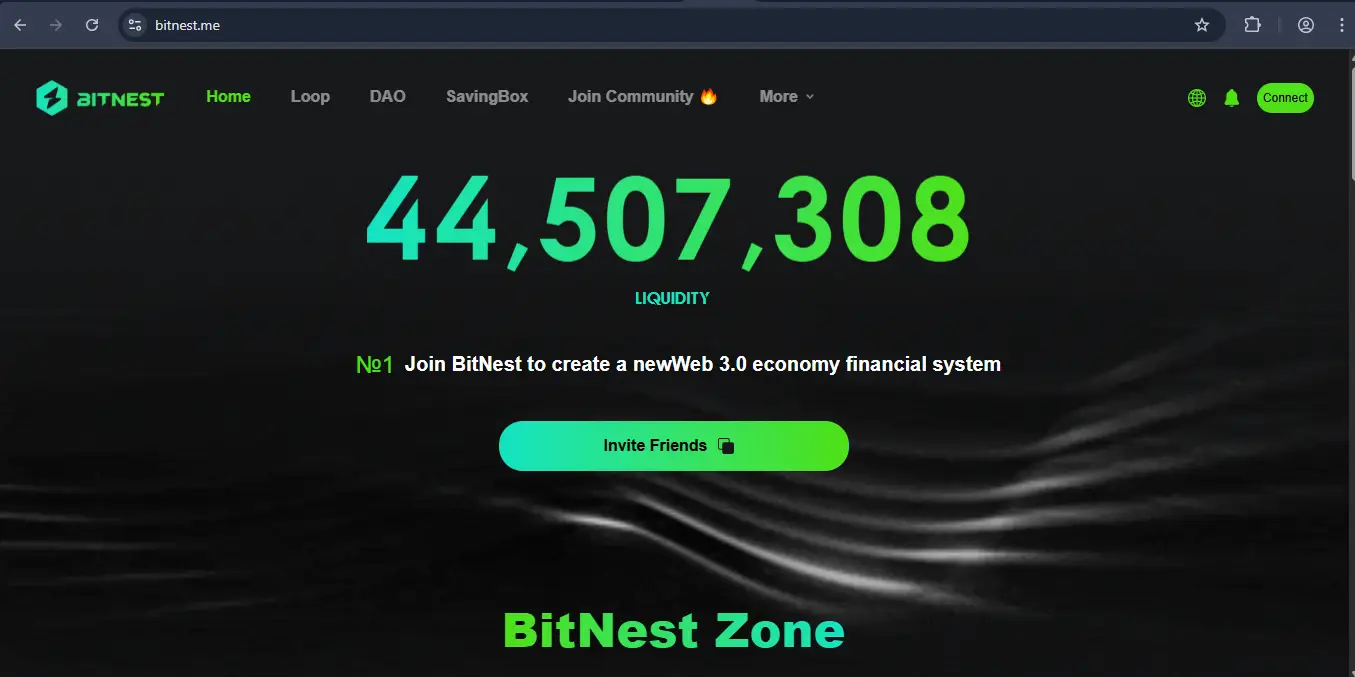
1. The Hacker Aesthetic
The entire site uses an aggressive black and green neon design. This is not an accidental design choice; it is psychological warfare. It is designed to mimic the aesthetic of “The Matrix” or what a Hollywood movie thinks “coding” looks like. It tricks non-technical users into thinking high-level computing is happening in the background. In reality, it is just a cheap CSS theme designed to dazzle you.
 Click to Zoom
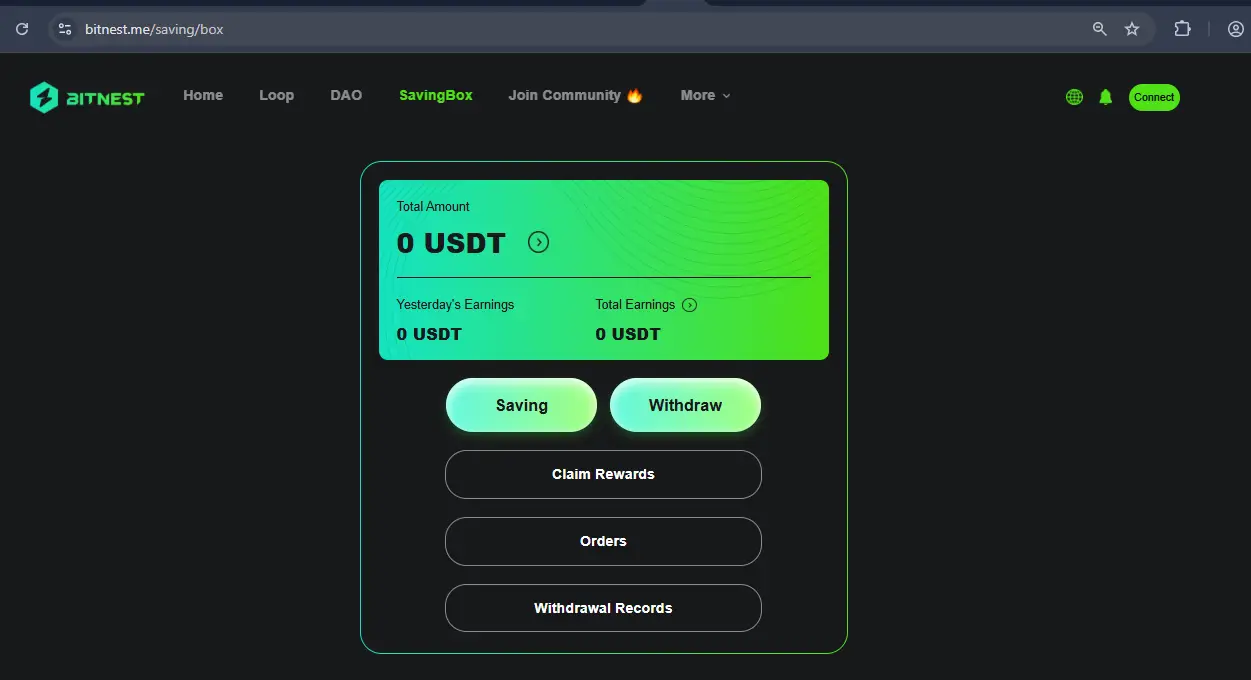
2. The SavingBox Feature
They have a core feature literally called “SavingBox.” Read that again.
Real banks, investment firms, and serious DeFi protocols use terms like “Staking Pool,” “Liquidity Provision,” or “Yield Farming.” They do not use childish terms like “SavingBox.” This language is deliberately simplified to target people who have zero experience with crypto. It disarms you by making the process sound like a piggy bank, rather than a high-risk derivative.
The $34 Million Liquidity Hoax
The biggest selling point of BitNest—and the reason your friend is begging you to join—is the bold claim on their homepage: “Total Liquidity: $34,158,662”
This number is a lie. It is a fabrication.
As an IT professional, I inspected the source code of the homepage. In a real DeFi project, the “Total Value Locked” (TVL) is fetched dynamically from the blockchain. You can see the code querying the smart contract to see how much money is actually there.
On BitNest, that number is hard-coded HTML text and a simple Javascript counter that increases automatically every time you refresh the page. It is not connected to a blockchain. It is a fake digital scoreboard designed to create “Social Proof.”
If BitNest really has $34 Million, where is it?
- Ask their support for the Liquidity Pool Contract Address.
- Paste that address into Etherscan or BscScan.
- Does that address hold $34 million?
The answer is No. It likely holds zero, or it routes funds directly to a mixing service (like Tornado Cash) to wash the stolen funds. Real liquidity is transparent. BitNest is opaque.
The Whac-A-Mole Domains
Legitimate companies buy one domain and keep it forever. Google is always Google.com. Binance is always Binance.com.
BitNest is playing a game of “Whac-A-Mole” with internet authorities. As soon as one domain gets flagged as a scam by Google Safe Browsing or taken down by a hosting provider, they simply upload the same code to a new, cheap domain extension.
Known BitNest Domains to Avoid:
- bitnest.ac
- bitnest.pro
- bitnest.me
- bitnest.us
- bitnest.finance
- bitnest.to
- bitnest.la
- bitnest.ad
- bitnest.is
- bitnest.cx
- bitnest.community
- bitnest.sbs
- bitnest.so
- bitnest.my
- bitnest.bz
- mecex.me
If you see any URL containing “BitNest” followed by a random collection of letters, DO NOT CLICK IT. These domains are often registered anonymously just days before the scam launches.
The Mechanics of the Scam
BitNest follows a specific script known in the cybersecurity world as Pig Butchering (Sha Zhu Pan). They do not steal your money immediately. They fatten you up before the slaughter.
1. The Bait
You connect your wallet and deposit a small amount, maybe $50 USDT. The dashboard shows you earning 3% to 5% daily. This is an impossible return in the real world, but on BitNest, the numbers go up.
They let you withdraw $5 of profit. You click withdraw, and the money actually hits your wallet. This is the most dangerous moment. You now believe the system is real. You think you have found a glitch in the matrix.
2. The Hook
Now that you “trust” them, you become their marketing agent. You tell your friends, your family, your WhatsApp groups. You deposit $1,000. Maybe you take a loan to deposit $5,000, thinking you will pay it off in a month. You watch your “SavingBox” balance grow to $10,000. You feel rich.
3. The Rug Pull
One day, you try to withdraw that $10,000. Error. The withdrawal stays “Pending” forever.
You contact support. They tell you there is “High Network Congestion” or that your account has been flagged for “Security Verification.” They will tell you that you need to deposit another $500 as a Tax Fee or Verification Fee to unlock your funds.
DO NOT PAY IT. If you pay the fee, they will steal that too. The money is already gone. The numbers on the screen are just pixels.
The Connect Wallet Technical Trap
This is the part that most beginners do not understand, and it is how BitNest empties wallets of people who think they are safe.
When you use a legitimate site, you “Sign” a login request. When you use BitNest, you are interacting with a malicious Smart Contract.
Hidden inside the “Join Node” or “Activate” button code is a function typically called approve or increaseAllowance.
The Security Guard Analogy:
- Signing In: This is like showing a security guard your ID card. They know who you are, but they cannot go into your house.
- Approving a Smart Contract (BitNest): This is like giving the security guard the keys to your house and a signed letter saying, “You are allowed to take up to 1,000,000 USDT from my safe whenever you want, without asking me again.”
Once you click that button in your Trust Wallet or MetaMask, you have authorized the theft. They do not need your password. They do not need your 12-word seed phrase. You gave them a digital key.
They might not steal your crypto today. They might wait until you deposit more, or until you are sleeping. Then, a script runs, executes the transferFrom function, and your wallet hits zero.
The Referral Ponzi Trap
BitNest pushes its referral program aggressively. “Invite 3 friends, get upgraded to VIP 2!”
Real banks do not pay you to recruit people. Real stocks do not require you to bring in new investors to get paid. Ponzi schemes do.
In a Ponzi scheme, there is no underlying business. There is no trading bot. There is no AI. The money to pay the “Old Investors” comes 100% from the “New Investors.”
When you invite your friends to BitNest, you are not helping them. You are feeding them into the machine to pay for your own temporary withdrawals. When the scheme collapses and it will collapse, you will be the one they blame.
Conclusion
BitNest is not Web 3.0. It is Theft 2.0.
It exploits the confusion around cryptocurrency to steal from the vulnerable. It uses cheap psychological tricks (Neon colors, Fire emojis) and dangerous technical traps (Unlimited Token Approvals).
Disconnect your wallet immediately. Do not put another cent into this platform.
Frequently Asked Questions
Is BitNest legit or a scam?
BitNest is a confirmed high-risk scam. It lacks a GitHub repository, has no public team, uses fake liquidity counters, and operates on disposable domains to avoid law enforcement.
I already connected my wallet. Is my money safe?
No. If you connected your wallet, your funds are at risk of being drained at any moment. Simply closing the website is not enough. You must revoke the permissions.
Have you been scammed?
If you have lost money or suspect a website is fake, report it to us immediately to warn others.
REPORT A SCAM NOW