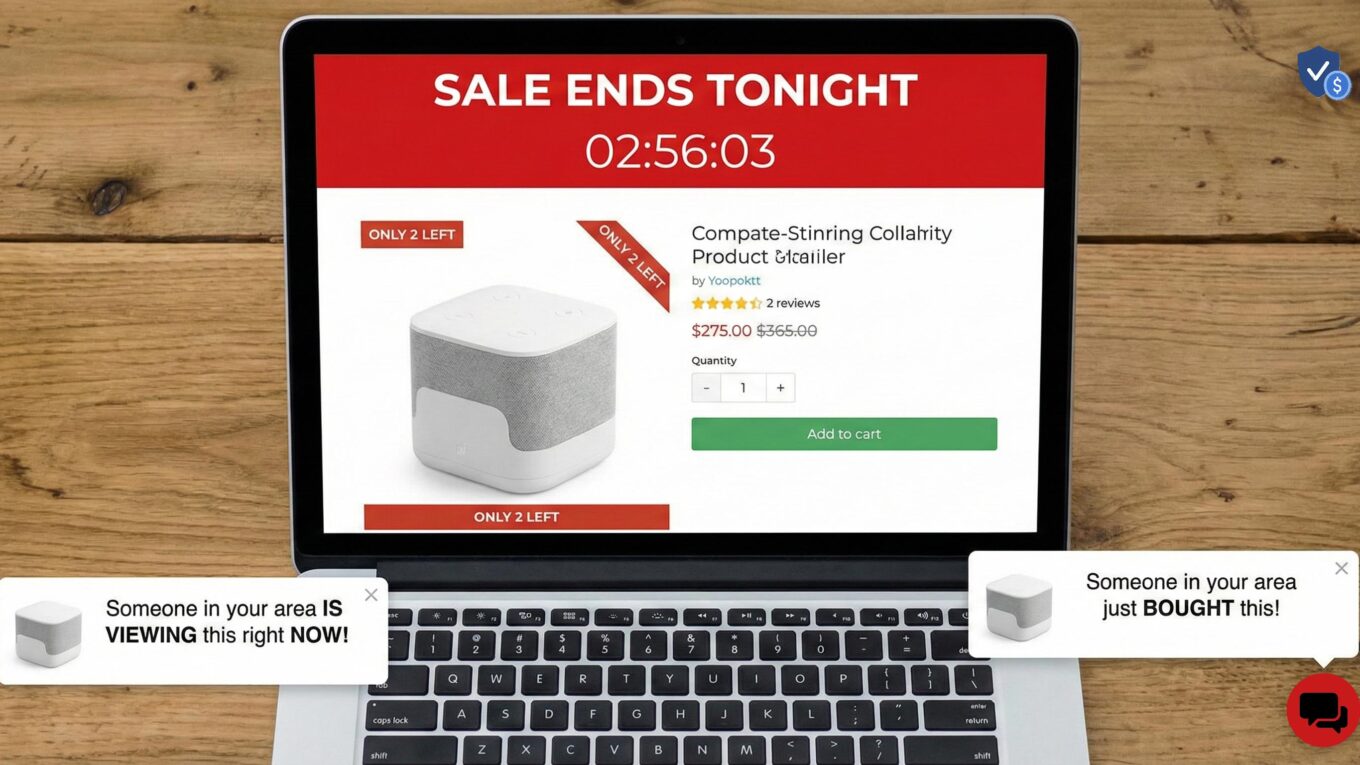
The ‘Sale Ends Tonight’ Scam – What You Need To Know
Picture this. You are scrolling through your social media feed at 11:30 PM. You spot a gadget, maybe a tactical flashlight or a posture corrector that looks interesting. You click the link.
Boom. A massive red banner at the top of the screen screams: “FLASH SALE! 50% OFF – ENDS IN 04:59.”
Your heart rate kicks up a notch. You scroll down. Another warning: “Only 2 items left in stock!” Then, a little pop-up in the corner tells you, “Mary from Texas just bought this 10 seconds ago.”
You were just curious a minute ago, but now you are in a race. You grab your wallet. You fumble with your credit card details, sweating as the timer hits 00:30. You hit “Pay Now” just as the clock reaches zero. You breathe a sigh of relief. You made it. You beat the clock.
Now, stop.
I want you to try something. Open that same website in a new tab. Better yet, refresh the page.
Look at the timer. Is it back at 05:00?
If it is, congratulations. You haven’t just bought a flashlight; you’ve bought into a lie. You have fallen victim to the Sale ends tonight scam.
What is “False Urgency”?
In the world of online safety and fraud prevention, we call these Dark Patterns. These are user interface designs carefully crafted to trick your brain into doing things you didn’t mean to do—like spending money on junk you don’t need.
The specific psychological weapon being used here is False Urgency.
Websites use this because it hacks your brain’s fear response. When we feel like resources are scarce (limited time, limited stock), our logical brain shuts down, and our primal brain takes over. We stop asking important questions like, “Is this website legitimate?” or “Is this price actually good?” and we switch to survival mode: “Grab it before it’s gone.”
Here is the dirty little secret: 90% of these “emergencies” are coded lies. The sale isn’t ending. The stock isn’t low. And Mary from Texas? She doesn’t exist.
Let’s break down the three main tools scam sites use to manipulate you.
1. The Perpetual Timer
This is the most common tool in the scammer’s toolkit. It’s the fake countdown timer.
You will usually see this right under the “Add to Cart” button or pinned to the top of the screen. It often features a jarring color scheme—bright red or neon orange against a white background—to signal danger.
How It Works
You might think this timer is linked to a real inventory system or a global sales clock. It isn’t. It is usually a simple script (a few lines of code) running locally on your web browser.
When you land on the page, the code says, “Start counting down from 5 minutes.” When the timer hits zero, one of two things happens:
- The Loop: It immediately resets to 5 minutes.
- The Refresh: The page reloads itself, and the timer starts over.
I have audited countless dropshipping scams where the website code explicitly states that the timer should reset every time a new visitor arrives. It is theatre. It is a prop designed to induce anxiety.
The Cookie Trick
Smarter scammers know that you might refresh the page to check. So, they place a “cookie” (a small tracking file) on your browser. This cookie remembers that you visited the site 2 minutes ago. If you refresh, the timer remembers where you left off, making it look real.
But if you clear your browser history or switch devices? The magic spell breaks, and the timer restarts.
The Time-Travel Refresh
Next time you see a timer ticking down to zero:
- Wait for it to get under 1 minute.
- Refresh the page immediately.
- Does it jump back to 10 or 15 minutes?
If the time jumps back, it’s a fake. A real sale ends at a specific time (e.g., midnight), not 10 minutes from whenever you personally happened to click the link.
2. The “Low Stock” Lie
“Hurry! Only 3 left in stock!”
This phrase is designed to trigger “Scarcity Bias.” We assign more value to things we think are rare. If there are only three left, it must be valuable, right?
Here is the reality of modern e-commerce, specifically regarding dropshipping.
Most of these websites do not own a warehouse. They do not have shelves. They do not have stock. When you buy the item from them for $50, they turn around and order it from a Chinese marketplace (like AliExpress) for $5 and have it shipped directly to you.
Since they don’t hold the inventory, they have no idea how much stock is actually left.
The Random Number Generator
I have inspected the source code of these product pages. Often, the “stock count” is just a random number generator. The code looks something like this:
Display Random Number between 2 and 7.
Every time you view the page, the website rolls a dice and tells you that’s how many are left. It is a digital fabrication.
The “Reserved” Cart Trick
Another variation of this is the cart timer: “Your item is reserved for 09:59.”
This implies that the item has been taken off the shelf and put in a box with your name on it. This is almost always false on Shopify dropshipping stores. Your item is not reserved. It is still sitting in a massive warehouse in Shenzhen, waiting for anyone to buy it. The timer is just there to stop you from price-checking on Amazon.
The “Cart Stuffer” Method
If the website says “Only 2 Left!”:
- Click “Add to Cart.”
- Go to your cart and change the quantity to 100.
- Try to checkout.
If the site lets you proceed to checkout with 100 items when they claimed they only had 2, they are lying. A legitimate inventory system would block the transaction and say, “Sorry, we only have 2.”
3. The “High Demand” Pop-up
You are reading the product description, and suddenly a small white bubble slides in from the bottom left corner:
“Someone in London, UK just purchased the ‘Ultra-Zoom Monocular'” “Julie from Ohio just bought…”
This is called “Social Proof.” In the physical world, social proof is seeing a long line outside a restaurant and assuming the food is good. Online, scammers have to fake that line.
The Bot Army
While legitimate apps exist that track real sales, scammers use “notification simulators.” These apps allow the store owner to write a list of fake names and fake cities.
They can set these to pop up every 5 to 20 seconds to make the store look incredibly busy. The goal is to make you feel like you are competing against thousands of other shoppers.
If “Julie from Ohio” really bought that item 5 seconds ago, and the store really only has “2 items left,” the stock should be gone by now. But it never is.
The Logic Check
Watch the pop-ups for a full minute.
- Count how many sales supposedly happen.
- Compare it to the “Stock Left” counter.
If 10 people supposedly bought the item in the last minute, but the “Only 3 Left” counter hasn’t moved, you are looking at a programmed illusion.
How to Expose the Lie
Now that you know how the Sale ends tonight scam works, you need a protocol. You need a way to shop without getting manipulated.
As an advocate for digital safety, I teach the “S.I.C.” Method (Stop, Incognito, Check).
1. The “Refresh” Test (Stop)
As mentioned in the hook, this is your first line of defense. When you feel panic, hit the F5 key (refresh). If the timer resets, the urgency is fake. If the timer resets, the deal is not real.
2. The “Incognito” Test (Incognito)
Online stores track you. They know if you’ve been there before. They know if you put an item in the cart and left (abandoned cart).
To see the real price and the real timer:
- Copy the URL of the product page.
- Open a “Private” or “Incognito” window in your browser (Ctrl+Shift+N on Chrome).
- Paste the link.
Often, you will find that the “Special 50% Off Price” that was “Just for you” is actually the standard price for everyone, every day. You might even find the price is lower for a “new” customer than it was for you.
3. The Reverse Image Search (Check)
This is the ultimate way to spot dropshipping scams.
- Right-click the product image.
- Select “Search Image with Google” (or save it and upload it to Google Lens).
You will likely find that the $50 “Sale” item is available on AliExpress, Temu, or Amazon for $12. The “Sale Ends Tonight” urgency was just a way to stop you from finding the real price.
Why It’s Dangerous
You might be thinking, “So what? Even if the timer is fake, maybe I still want the product.”
Here is why false urgency is dangerous to your financial health.
When you rush, you skip due diligence. The scammers know that if they give you 24 hours to think, you might:
- Search for reviews (and find none, or find terrible ones).
- Check the “About Us” page (and find it’s full of lorem ipsum filler text).
- Check the domain age (and realize the website was created yesterday).
By forcing you to act in 5 minutes, they force you to bypass the safety checks that protect you from credit card theft and identity fraud. You aren’t just risking $50 on a bad product; you are handing your credit card data to a merchant who has already proven they are willing to lie to you to get a sale.
If they lie about the timer, and they lie about the stock, what makes you think they are telling the truth about shipping times, refund policies, or data security?
Conclusion
The internet is a marketplace, but it is also a battlefield for your attention and your wallet.
The next time you see that countdown timer ticking away the seconds, or the flashing red warning that stock is critical, take a deep breath.
A real sale on a legitimate website will still be there in 10 minutes. A legitimate business does not need to terrify you into becoming a customer.
If you have to rush, it’s a hush-job. If you have to panic, it’s a predatory tactic.
Close the tab. Save your money. Don’t let a line of code tell you what to do.
