
Top 10 Deceptive Earning Schemes You Must Avoid This Year

 Click to Zoom
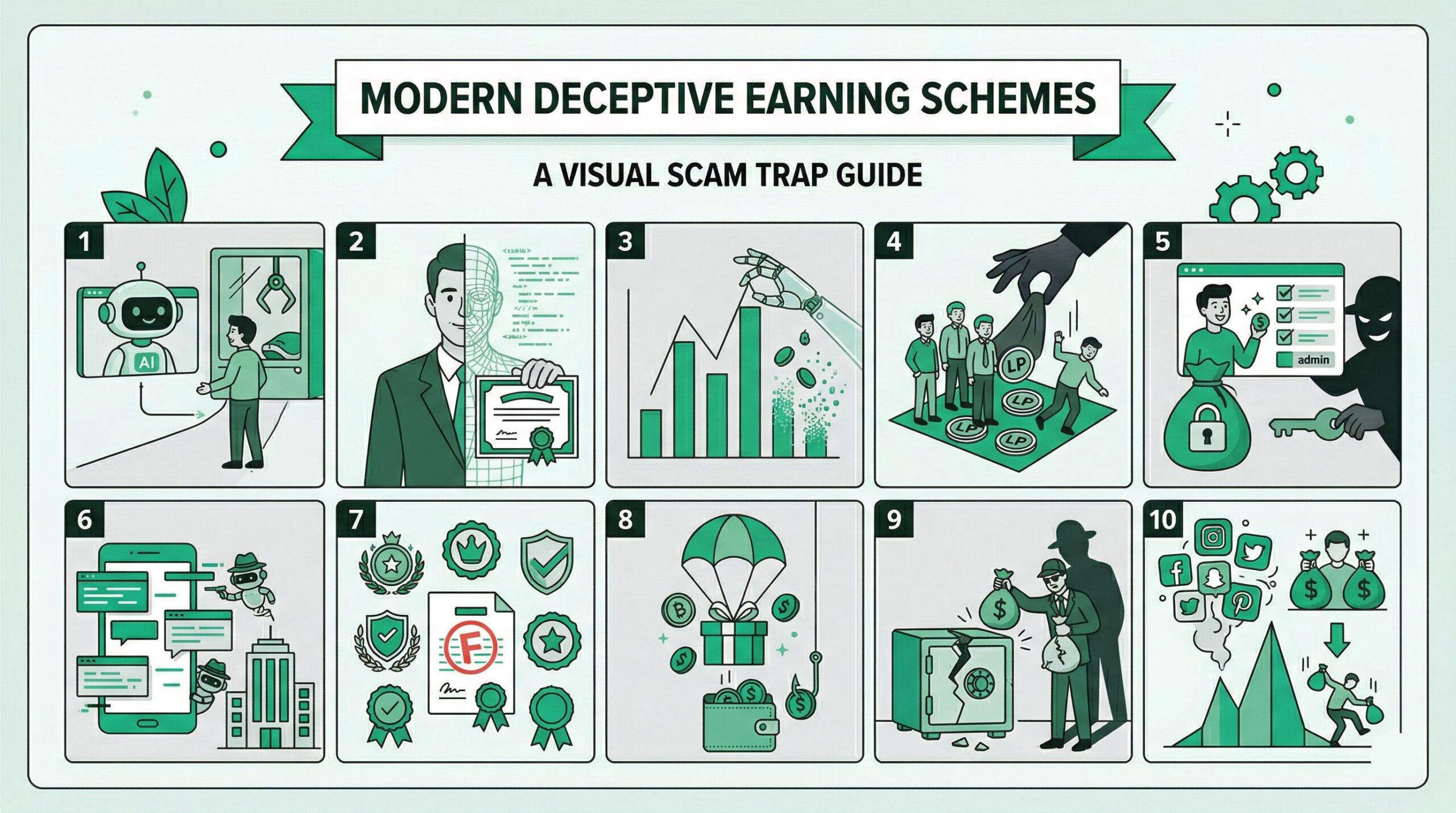
Your money is under attack. In 2026, financial fraud operates at machine speed. Criminal syndicates now deploy autonomous artificial intelligence, scrape your digital footprint, and execute hyper-personalized financial attacks designed to drain your accounts before you realize you are a target. You are not facing lone hackers. You are facing industrialized fraud networks with billion-dollar operational budgets.
Click to Zoom
Your money is under attack. In 2026, financial fraud operates at machine speed. Criminal syndicates now deploy autonomous artificial intelligence, scrape your digital footprint, and execute hyper-personalized financial attacks designed to drain your accounts before you realize you are a target. You are not facing lone hackers. You are facing industrialized fraud networks with billion-dollar operational budgets.
Every digital interaction regarding your finances requires intense scrutiny. The methods used to steal your wealth have evolved far beyond poorly written emails. Below are the ten most destructive earning schemes active this year and the exact analytical methods you must use to dismantle them.
1. AI-Powered Pig Butchering Schemes
Pig butchering is a long-term financial con where scammers build deep emotional trust with a victim before convincing them to deposit funds into a fraudulent investment platform. In 2026, criminal syndicates use artificial intelligence to manage thousands of these emotionally manipulative relationships simultaneously, creating customized scripts based on the psychological profile of each target.
The attack vector begins subtly on dating apps, professional networking sites, or through supposedly accidental text messages. The fraudster spends weeks building rapport without mentioning money. Once trust is absolute, they introduce a highly lucrative trading opportunity. The victim is directed to a sophisticated but entirely fabricated trading platform.
Red Flags:
- Refusal to engage in live, unscripted video calls.
- Unsolicited advice regarding exclusive cryptocurrency or foreign exchange trading nodes.
- Instructions to move funds from a regulated bank to a specific, unknown trading application.
Fund Flow in Pig Butchering Operations
| Attack Phase | Perpetrator Action | Financial Mechanism | Victim Visibility |
| Grooming | Daily relationship building | None | Illusion of friendship |
| The Hook | Encouraging a small test trade | Transfer to legitimate exchange | Real platform dashboard |
| The Pivot | Directing funds to a dark platform | Unregulated blockchain transfer | Fabricated high-yield dashboard |
| The Slaughter | Account lock and tax demands | Irreversible crypto extraction | Total loss realization |
2. Synthetic Deepfake Investment Brokerages
Synthetic brokerages are entirely fabricated financial platforms promoted by AI-generated videos of recognizable business leaders or celebrities. The scammers clone voices and alter video footage to make it appear as though high-profile billionaires or political figures are endorsing guaranteed wealth multiplication systems.
These deepfake videos are weaponized across social media algorithms to target specific demographics. Victims click the ad and enter a seamless onboarding funnel that mimics top-tier financial institutions. The moment funds are wired, the money is laundered through international shell companies.
Red Flags:
- Endorsements of guaranteed returns from public figures who do not historically sell retail investment products.
- Pressure to fund the account using cryptocurrency rather than standard bank routing protocols.
- Disconnects between the advertised platform URL and the actual domain hosted in the browser address bar.
3. Phantom Algorithmic Trading Bots
Phantom algorithmic trading bots are highly marketed software tools that promise to generate guaranteed daily profits through automated market arbitrage. The underlying trading algorithm does not actually exist. Victims are purchasing access to a simulated dashboard that displays fake account growth while the operators siphon the initial deposit.
These schemes prey on the desire for passive income. They use complex technical jargon regarding high-frequency trading and quantum arbitrage to confuse retail investors.
Legitimate Trading Architecture vs. Phantom Bot Scams
| Architectural Feature | Legitimate Institutional Software | Phantom Bot Scam |
| Exchange Connection | Requires secure API keys to your existing broker | Requires direct deposit into their proprietary system |
| Profit Viability | Variable yields with clear risk of total loss | Guaranteed daily or weekly percentage returns |
| Code Transparency | Auditable logic or regulated oversight | Black-box proprietary system with zero verifiable history |
| Asset Custody | You maintain control of the underlying assets | The platform takes immediate custody of your deposit |
4. Decentralized Finance Liquidity Pool Rug Pulls
A liquidity pool rug pull occurs when developers launch a new cryptocurrency token, attract investor capital to a decentralized exchange, and abruptly withdraw all underlying liquidity. This mathematical action instantly drops the token value to zero and traps investor funds permanently.
These operations rely heavily on manufactured social media hype. Developers pay influencers to promote the new token. Retail investors rush in to capture early gains, providing the liquidity the scammers need. The developers then trigger a hidden backdoor in the smart contract to extract every unit of value.
More Safety Guides


Red Flags:
- Anonymous development teams with zero verifiable professional history.
- Smart contracts that have not been audited by reputable third-party security firms.
- Tokenomics structures where a massive percentage of the supply is held in a single unlocked developer wallet.
5. Task-Based Employment Fraud
Task-based employment fraud tricks victims into believing they have been hired for a remote data entry or marketing role that requires upfront financial deposits. Scammers lure job seekers with high wages for simple work, then lock their fabricated earnings behind a demand for mandatory account upgrade fees.
The onboarding process looks completely authentic. Victims are given login credentials to an employee portal. They complete repetitive tasks and watch their virtual balance grow. When they attempt to withdraw their paycheck, the system demands a clearance fee, equipment deposit, or tax payment. The job is a mirage designed to drain the applicant.
Red Flags:
- Immediate hiring decisions made exclusively through encrypted messaging apps without formal interviews.
- Requests to purchase office equipment from a specific, unverified vendor using peer-to-peer payment apps.
- Requirements to pay a tiered activation fee to unlock earned wages.
6. Autonomous Agent-Driven Corporate Smishing
Autonomous smishing utilizes AI agents to send hyper-personalized text messages to corporate employees, impersonating executives or vendors to authorize urgent wire transfers. These systems scrape corporate filings and professional networks to reference real internal projects, making the deceptive texts nearly indistinguishable from authentic executive communications.
The traditional Business Email Compromise has evolved. Scammers now bypass email filters entirely by targeting mobile devices directly. They create a false sense of extreme urgency regarding a confidential acquisition or overdue vendor payment.
Red Flags:
- Urgent payment requests arriving outside of established corporate procurement channels.
- Instructions from supposed executives strictly forbidding the recipient from discussing the matter with other staff.
- Sudden changes to established vendor banking details delivered via text message.
7. Fraudulent Government Impersonation Networks
Government impersonation networks dispatch millions of automated alerts claiming the victim owes immediate toll fees, tax penalties, or customs duties. The messages contain malicious links directing users to exact replicas of official government portals designed to steal banking credentials and identity data.
In 2026, these networks utilize geographic targeting. If you drive on a specific toll road, you will receive a text about an unpaid balance for that exact road within hours. The phishing sites are flawless digital clones of legitimate civic infrastructure.
Red Flags:
- Government agencies demanding payment via cryptocurrency, retail gift cards, or direct wire transfers.
- Links in text messages that use URL shorteners to hide the true destination address.
- Threats of immediate physical arrest or license suspension for minor administrative fees.
8. Malicious Crypto Airdrops and Wallet Drainers
Malicious airdrops are deceptive promotional campaigns offering free cryptocurrency tokens to users who connect their digital wallets to a specific website. The smart contract on the target website actually contains wallet-draining code that automatically transfers all user assets to the attacker the moment permissions are granted.
This is a technical exploit disguised as a marketing giveaway. Victims believe they are signing a receipt to accept free assets. In reality, they are cryptographically signing a function that grants the scammer unlimited approval to spend the victim balances.
Red Flags:
- Unsolicited tokens suddenly appearing in your wallet containing links to external claiming websites.
- Promoted posts on social media platforms advertising surprise giveaways from major blockchain networks.
- Wallet prompts requesting unlimited token approval rather than a simple signature for receipt.
9. Secondary Asset Recovery Extortion
Secondary asset recovery extortion targets individuals who have already lost money to an investment scam. Fraudsters pose as specialized cybersecurity lawyers or government agents, promising to retrieve the stolen funds in exchange for an upfront retainer fee or blockchain gas payment.
These predators purchase lists of known fraud victims from the dark web. They know exactly how much you lost and who stole it because they are often the exact same criminal syndicate running the original scam. They leverage your desperation to extract a final payment.
Red Flags:
- Unsolicited contact from organizations claiming they have already tracked your stolen funds to a frozen account.
- Demands for upfront taxes, legal retainers, or network fees before the recovered funds can be released.
- Communications utilizing free email services rather than verifiable corporate or government domains.
10. Social Media Microcap Pump-And-Dump Operations
Pump-and-dump operations manipulate the price of low-value digital assets or penny stocks through coordinated social media hype. Insiders accumulate the asset cheaply, use aggressive marketing to drive up the price through retail investor fear of missing out, and then sell off their holdings, leaving late buyers with worthless assets.
This scheme operates in plain sight. Private messaging groups coordinate the exact minute to begin aggressively buying and promoting a worthless asset. Retail investors see the massive upward price momentum and buy in. The insiders then liquidate their positions simultaneously, crashing the market instantly.
Red Flags:
- Sudden explosions in trading volume for assets with zero fundamental business value or utility.
- Aggressive promotion by anonymous social media accounts claiming inside knowledge of an impending massive price spike.
- VIP trading groups that charge a subscription fee for access to exclusive market signals.
Defending your wealth requires absolute operational security. Verify every communication through independent channels. Never allow urgency to override your forensic verification processes. If an earning mechanism lacks transparency, you must assume it is a trap.
Subscribe for alerts on new scams and real opportunities.
Have you been scammed?
If you have lost money or suspect a website is fake, report it to us immediately to warn others.
REPORT A SCAM NOW