The ClickWages Buzz Earning Scam – What You Need To Know
 Click to Zoom
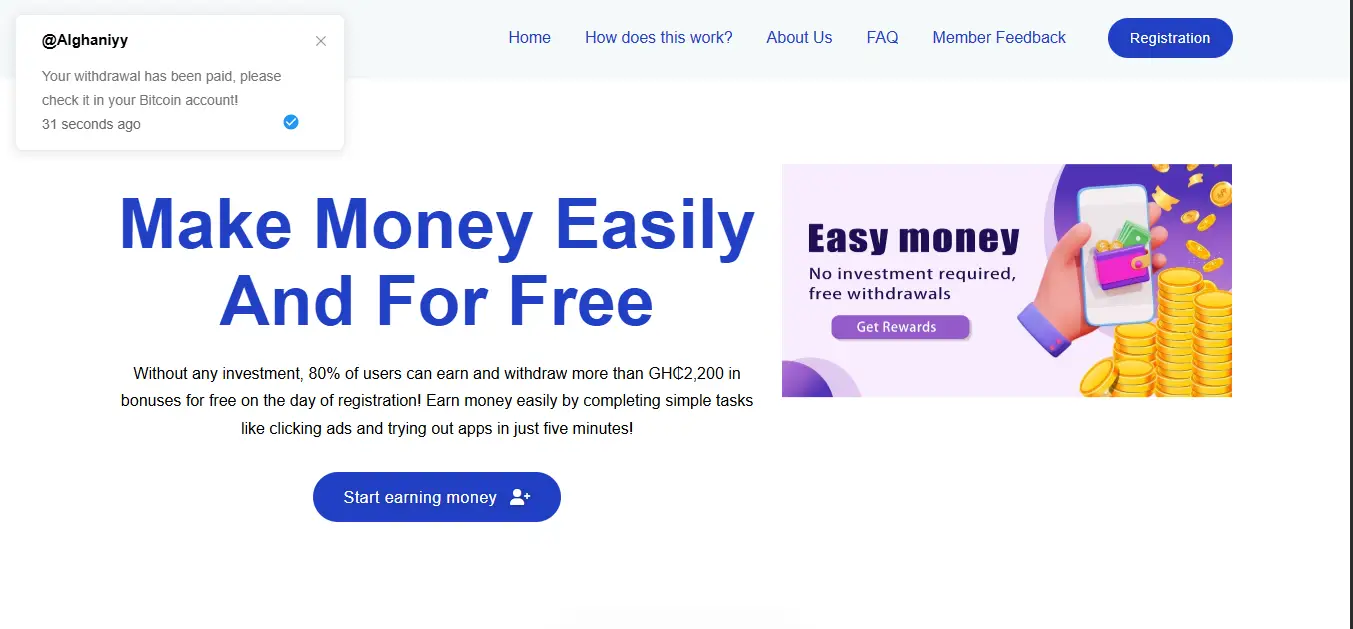
If you are reading this, you probably saw a link on WhatsApp or Facebook that screamed something like: “Register now and get GH₵2,200 instantly!” or “Make money online in Ghana just by clicking ads!”
The website in question is Clickwbwages.buzz (or one of its many copycats like clickjewages.buzz or Clickwages.buzz).
The promise is intoxicating. In an economy where prices are rising and the Cedi is struggling, the idea of tapping your phone screen a few times to earn more than a bank manager’s daily salary is a dream come true.
But I am here to wake you up.
I have spent the last 48 hours dissecting Clickwbwages.buzz. I signed up, I “clicked” their ads, and I tried to withdraw. I did this so you don’t have to lose your time, your data, or your money.
Clickwages is 100% a scam. It is a sophisticated data-harvesting scheme designed to trick you into spamming your friends and handing over your personal information.
Sit tight. In this review, I am going to break down exactly how they trick you, why the money isn’t real, and show you the mathematical proof that their business model is a lie.
The Hook
Here is why it feels so real.
The moment you land on any of the Clickwages website, everything is designed to bypass your logical brain and target your greed.
Recommended Articles
You see a sleek dashboard. You see a “Live Payout” notification popping up in the corner: “Kwame from Accra just withdrew GH₵450.” “Fatima from Lagos just withdrew GH₵1,200.”
It looks official. The numbers in your balance go up every time you click. You feel productive. You feel like you’ve finally found the “secret” that everyone else is missing.
But ask yourself this simple question before we go further:
If a company could generate GH₵2,000 in profit just by having you click a few buttons for 5 minutes, why would they need you? Why wouldn’t they just build a robot to click the buttons 24/7 and keep all the billions for themselves?
The answer is: They don’t pay you because the money doesn’t exist.
 Click to Zoom
Economic Reality Check
Let’s put aside the hype and look at the hard economics of the internet. I want you to understand why this is a scam, so you never fall for a similar site again.
Legitimate websites earn money through Advertising Revenue. When you visit a site like Earn More Cash Today or watch a YouTube video, the creator gets paid a tiny amount by advertisers.
The Real Cost of a Click
In the digital marketing world, we track earnings using a metric called CPC (Cost Per Click).
- Legitimate Ad Networks (Google AdSense, etc.): Pay publishers roughly $0.01 to $0.10 (GH₵0.15 to GH₵1.50) per click in regions like Africa.
- Clickwages Promise: They claim to pay you GH₵100 to GH₵500 per task.
Think about that.
For Clickwages to pay you GH₵100 for a single click, they would need to be charging the advertiser GH₵200 or more to make a profit.
No legitimate company on earth—not MTN, not Coca-Cola, not Apple is paying GH₵200 just to have one random person look at their logo for 3 seconds. It is economic suicide.
If Clickwages actually paid what they promised, they would go bankrupt in 15 minutes.
How the Scam Works
These websites operate on a specific script. I call it the “Hope Loop.” Here is what happens when you sign up.
The Bait
They make signing up incredibly easy. No email verification, no ID check. You can literally type “fakeuser123” and a random password, and you are in.
Why? Because they want to lower the barrier to entry. They want to get you inside the dashboard seeing those fake numbers as fast as possible.
The Hook
Once you are in, you are presented with “tasks.” These are usually:
- Clicking an ad.
- Solving a simple math problem (2+2=?).
- Downloading a sketchy app.
Every time you do this, your dashboard balance jumps up. GH₵500… GH₵1,000… GH₵2,200.
You are excited. You are already calculating what you will buy. A new phone? A laptop? Paying off school fees? This is the “Dopamine Rush.” The fake numbers on the screen feel like real money in your pocket.
The Trap
This is where the knife twists.
You hit the “Withdraw” button. You select “Mobile Money” or “Western Union.” You are ready to get your cash.
STOP.
A popup appears:
“To withdraw your funds, you must first verify you are human by sharing your referral link with 15 friends on WhatsApp or 5 groups.”
This is the core of the scam. They are using YOU to find their next victims. They know you trust your friends, and your friends trust you. By forcing you to spam your WhatsApp contacts, they get free advertising.
You think, “Okay, let me just share it. It’s annoying, but for GH₵2,200, I’ll do it.”
The Ghosting
You share the link. You annoy your friends. You come back. You hit Withdraw again.
Now, one of two things happens:
- The “Server Error”: The site claims the server is busy, or your withdrawal is “Pending Approval” for 30 days. It will stay pending forever.
- The Verification Fee: They ask you to send a “small processing fee” (usually GH₵50 or GH₵100) to “verify your Mobile Money account.”
NEVER PAY THIS. If you send them money, it is gone. They will block your account immediately after receiving it. A legitimate employer pays you. They never ask you to pay them to get your salary.
The Promise vs. The Reality
Let’s look at a direct comparison of what Clickwages promises versus what actually happens.
| Feature | The Clickwages Promise | The Harsh Reality |
| Earnings | GH₵2,200+ per day | GH₵0.00 (Fake pixels on a screen) |
| Work Required | 5 minutes of clicking | Hours of spamming friends & family |
| Registration | Free & Instant | Data harvesting for spam lists |
| Withdrawal | Instant to Mobile Money | “Pending” forever or requires a fee |
| Support | 24/7 Customer Care | Non-existent bots |
| User Reviews | “Best site ever!” (Fake) | “They stole my time/money” (Real) |
The Red Flags
You don’t have to take my word for it. Let’s look at the digital forensics.
1. The Domain Age
Legitimate earning platforms like Upwork or Fiverr have been around for over a decade.
I ran a WHOIS lookup on clickwbwages.buzz.
- Registered: 2025-07-12.
- Registrar: NameSilo, LLC.
- Expiration: 1 year (Scammers only buy domains for 1 year because they know the site will be shut down before then).
A website that was born yesterday does not have the liquidity to pay out millions of Cedis to users.
2. Fake Social Proof
You know those little popups? “Adam just got paid $500”?
That is not real data. It is a simple line of Javascript code running on a loop. It cycles through a list of fake names and random dollar amounts. You can inspect the website code (Right Click -> Inspect) and often see the list of fake names right there in the script. It is theater, nothing more.
3. The Typos and Domain Extensions
Notice the extension: .buzz. Legitimate businesses usually use .com, .net, .org, or country codes like .com.gh.
Scammers use .buzz, .xyz, .top, or .online because these domains are incredibly cheap to buy (often less than $1).
Also, look for typos. I have seen variations like clickwbages.buzz or clikwages.com. This is called “Typosquatting.” If a “professional” company cannot spell its own name correctly, run away.
4. No Contact Information
Go to the “Contact Us” page. Is there a physical office address in Accra? Is there a phone number you can call? Likely, there is just a generic email form. Scammers operate from the shadows. They do not want you showing up at their office when they refuse to pay you.
Conclusion
Clickwages is a mirage. It is a digital trap designed to exploit your financial anxiety.
- The money on the screen is fake.
- The testimonials are fake.
- The “share to withdraw” requirement is a blocking tactic.
Do not let them use you to trick your friends. If you have already signed up, do not panic. Change your passwords, ignore their emails, and do not pay any verification fees.
Be smart. Stay safe. And remember: If it sounds too good to be true, it is.
Subscribe for alerts on new scams and real opportunities.
Have you been scammed?
If you have lost money or suspect a website is fake, report it to us immediately to warn others.
REPORT A SCAM NOW