minifaith.com is a highly suspicious online store that relies on unrealistic discounts and aggressive promotions. While it might look like a bargain retailer at first glance, the operational reality is highly concerning. Users frequently report receiving counterfeit products, low-quality items, or nothing at all.
Furthermore, this site collects sensitive personal and financial information during checkout. Untrusted platforms often misuse this data, exposing users to risks of identity theft or payment fraud. This guide will explain exactly how platforms like minifaith.com operate, the specific warning signs you need to spot, and the steps you must take if you have compromised your information.
Quick Check
Trust Score for minifaith.com
25
Suspicious Website
Status
Online
First Time Checked December 15, 2025 01:47 AM
Domain Age 3 Months old (Nov 20, 2025)
Server Location
Ottawa, Canada (Cloudflare, Inc. (Shopify, Inc.))
minifaith.com presents itself as an online store offering a massive range of products at prices that seem too good to pass up. Unfortunately, historical patterns with similar storefronts suggest the platform’s operations are deceptive, often accepting payment without fulfilling orders.
On-Site Content
To understand how this platform markets itself, we analyzed the core messaging presented to shoppers. Here is a direct excerpt from their page:
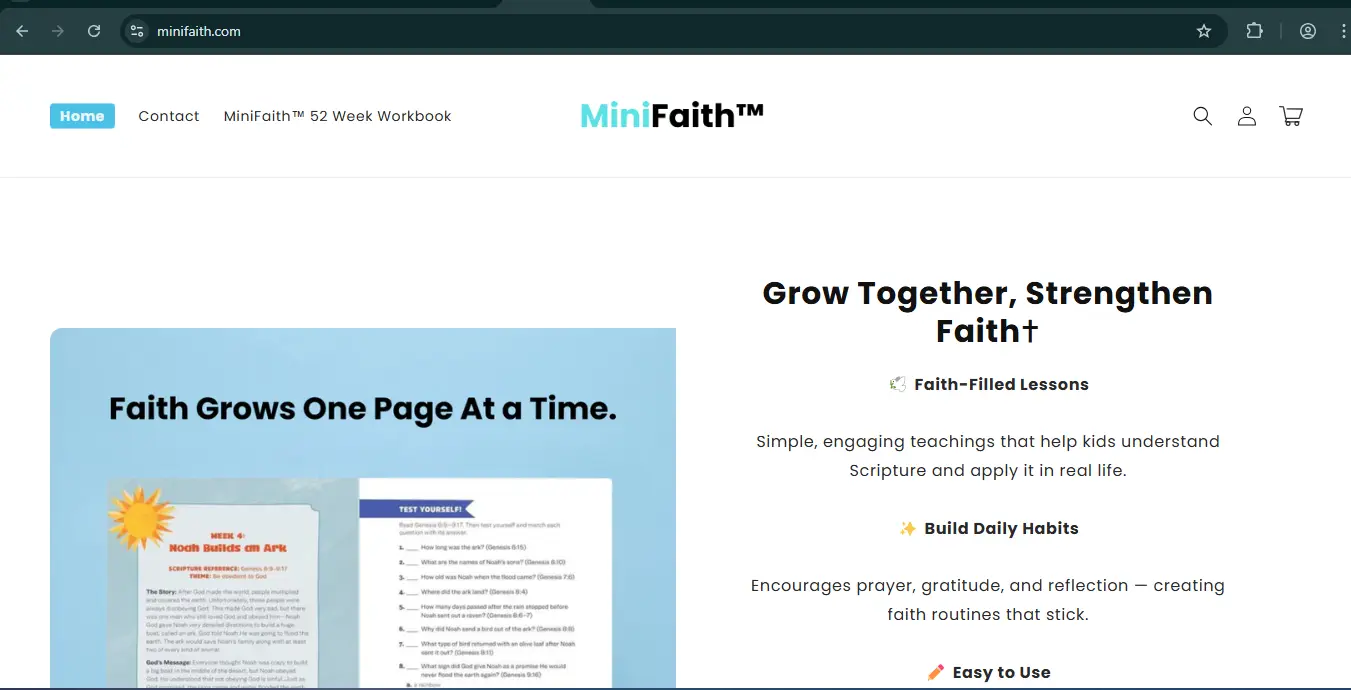
“🕊️ Faith Filled LessonsSimple, engaging teachings that help kids understand Scripture and apply it in real life.✨ Build Daily HabitsEncourages prayer, gratitude, and reflection creating faith routines that stick.✏️ Easy to UseJust open and learn together. No prep needed perfect for family devotion time or independent study.💗 Meaningfu…”
Third-Party Trust Validations
Legitimate platforms undergo rigorous third-party audits to verify their security standards and business practices. ScamSonar checked for outward links and verification seals from known authorities and found these:
Omnisend
Apple Pay
Google Pay
Technical Analysis
Our automated intelligence systems conducted a deep structural audit of minifaith.com to identify underlying technologies and hosting infrastructure. Understanding the digital foundation of a website is a critical step in verifying its overall legitimacy and corporate accountability.
Live Server Status
Online. The web server is currently active and reachable. Continuous server uptime is a hallmark of professional operations, while transient or frequently offline servers often correlate with burner networks designed to evade detection.
Technology Stack
The core software matrix running this platform is identified as Shopify. This represents the underlying software matrix powering the website. While this represents the underlying framework powering the website, it is important to note that scammers frequently manipulate open source or commercial platforms to quickly deploy deceptive storefronts.
Security Fingerprint
A comprehensive security teardown reveals exactly how this domain handles its network traffic and where its physical infrastructure is located in the world.
Connection Encryption
Modern web standards mandate secure, encrypted connections. Fortunately, this platform holds a valid SSL certificate. This ensures that any data transmitted between your browser and the server remains encrypted and protected from routine interception tactics.
Hosting Infrastructure
Hosted in Ottawa, Canada via Cloudflare, Inc. (Shopify, Inc.). Organizations operating out of highly regulated datacenter jurisdictions generally offer higher avenues for dispute resolution compared to those hiding behind offshore, bulletproof hosting providers.
Domain Registration
A primary factor in determining online legitimacy is the historical lifecycle of the domain name itself.
Active Lifecycle:
3 Months old (Nov 20, 2025)
A longstanding registration history definitively indicates business stability and a long term commitment to maintaining consumer trust. Conversely, newly minted domains often carry a substantially higher probability of transient or deceptive operations designed to vanish after a short period.
How They Attract Shoppers
Aggressive Advertising: They often run targeted campaigns on popular social media networks, leveraging compelling copy and seemingly high-value offers.
Unrealistic Pricing: To trigger impulsive purchases, they list heavily demanded products at steep discounts that contradict standard market values.
Primary Warning Signs
Opaque Operations: A lack of verifiable contact endpoints (such as a working phone number or physical corporate address) indicates an organization attempting to avoid public accountability.
Generic Legal Disclosures: Terms of Service and Privacy Policies often feature generic, templated text that fails to reflect the platform’s specific operational mechanics.
Artificial Urgency: The presence of countdown timers, low-stock alerts, and impossible discounts are common manipulative tactics used to hasten user transactions.
Digital Footprints
Legitimate organizations typically maintain an interconnected presence across digital ecosystems to foster community engagement and transparent customer support.
Consumer Trust Rating
Insufficient public review data available for aggregate scoring. The absence of third party reviews should be factored into your risk assessment.
Verified Social Channels
No verifiable social media connectivity detected. Networks that fail to provide outward links to established social media profiles often do so to avoid public scrutiny and negative comment threads.
Common Issues After You Buy
Problem
Description
Non-delivery
Most buyers never receive their orders after paying.
Fake or Inferior Items
Items sent are often cheap imitations or poorly made products.
Damaged or Used Goods
Some people receive products that are clearly second-hand or broken.
Wrong Products
The item in the box often differs entirely from what you ordered.
What to Do If You Have Transacted with minifaith.com
If you realize you have submitted payment to an unreliable platform, it is stressful, but you need to act fast to limit potential damages.
1. Contact Your Bank Immediately
The first step is to contact the bank or credit card provider involved in the transaction.
Credit Card: Request a chargeback. This is your best bet for getting your money back.
Wire Transfer: Contact the recipient bank promptly to seek a reversal, though I have to be honest, success is less likely here.
Secure Your Account: Ask your bank to block additional unauthorized charges. You should probably cancel the compromised card and get a replacement.
2. Keep Your Records
Do not delete anything. Keep thorough records of all interactions. Save your emails, receipts, transaction confirmations, and any conversations you had with the fraudulent party. This documentation is vital for winning disputes with your bank.
3. Secure Your Online Presence
Online security needs to be your priority right now. Change your passwords for any accounts that share credentials with the compromised site. You should also monitor your credit reports from major bureaus to spot unauthorized activity. If you suspect identity theft, placing a credit freeze adds an extra layer of protection.
4. Report the Scammers
Reporting the incident helps stop them from hurting others. Notify agencies such as consumer protection bodies and internet crime complaint centers. Provide them with full details and evidence.
You can also share your experience publicly. Posting on review sites and social media warns other people, but make sure you do not falsely accuse legitimate businesses. If you saw their ads on social media, report those accounts to the platform administrators.
Actionable Safety Protocols
Based on our forensic analysis of minifaith.com, we systematically recommend the following concrete consumer safety protocols before proceeding further:
Cross reference product pricing against established market baselines to detect highly unrealistic discounts commonly used as bait.
Refrain entirely from transmitting sensitive payment details if your browser fails to present a secure padlock icon confirming SSL encryption.
Investigate external discussion forums for independent, unfiltered conversations regarding the fulfillment reliability of this specific entity.
Validate the existence of a comprehensive return policy and confirm that physical contact infrastructure actually routes to a real, verifiable business location.
Detailed Forensic Schematics
For advanced investigators and cybersecurity analysts, the raw extraction telemetry is provided below for independent verification.
Whois Information:
Domain Name: MINIFAITH.COM
Registry Domain ID: 3040304008_DOMAIN_COM-VRSN
Registrar WHOIS Server: whois.tucows.com
Registrar URL: http://www.tucows.com
Updated Date: 2025-11-20T03:27:55Z
Creation Date: 2025-11-20T03:27:43Z
Registry Expiry Date: 2026-11-20T03:27:43Z
Registrar: Tucows Domains Inc.
Registrar IANA ID: 69
Registrar Abuse Contact Email: domainabuse@tucows.com
Registrar Abuse Contact Phone: +1.4165350123
Domain Status: clientTransferProhibited https://icann.org/epp#clientTransferProhibited
Domain Status: clientUpdateProhibited https://icann.org/epp#clientUpdateProhibited
Name Server: NS-CLOUD-B1.GOOGLEDOMAINS.COM
Name Server: NS-CLOUD-B2.GOOGLEDOMAINS.COM
Name Server: NS-CLOUD-B3.GOOGLEDOMAINS.COM
Name Server: NS-CLOUD-B4.GOOGLEDOMAINS.COM
DNSSEC: unsigned
URL of the ICANN Whois Inaccuracy Complaint Form: https://www.icann.org/wicf/
>>> Last update of whois database: 2026-03-01T13:00:24Z <<<
For more information on Whois status codes, please visit https://icann.org/epp
SSL Security Check
A valid SSL certificate has been detected. This cryptographic protocol ensures that sensitive data transmitted between your browser and this server, including login credentials and payment details, remains securely encrypted against unauthorized interception.
SSL Certificate Information:
Issuer: Google Trust Services
Valid From: January 18, 2026
Valid To: April 18, 2026
Detail Analysis of Server Server Details:
IP Address: 23.227.38.74
ISP: Cloudflare, Inc. (Shopify, Inc.)
Region: Ontario
Frequently Asked Questions About minifaith.com
Is it safe to buy from minifaith.com?
No, it is not recommended to purchase from this platform. minifaith.com has been flagged as highly unreliable, with users reporting failed deliveries, counterfeit items, and unauthorized use of collected customer data. Shoppers should avoid making any financial transactions.
What should I do if I ordered from minifaith.com?
Immediately contact your bank or credit card provider to report the fraudulent transaction. Request a chargeback, monitor your accounts for suspicious activity, and consider replacing your card to protect your finances.
How do I report minifaith.com as a fraudulent website?
You can report minifaith.com to the Federal Trade Commission (FTC) at reportfraud.ftc.gov. Choose Online Shopping as the issue and include all transaction details. Victims outside the U.S. should report to their local consumer protection authority.
Who is Behind minifaith.com?
Research suggests platforms operating like minifaith.com are often part of larger, interconnected networks likely operating from overseas. These networks frequently rotate through multiple domains to evade detection and continue deceptive practices.
Can I get my money back from minifaith.com?
If you paid by credit card, you may be able to recover your money through a chargeback. Banks are often willing to review and reverse transactions when a merchant is flagged for deceptive practices. Refunds are exponentially less likely with wire transfers or prepaid cards.
Can my identity be compromised by minifaith.com?
Yes. By entering your details on highly suspicious platforms like minifaith.com, you risk exposing your data. To reduce risk, rotate your passwords immediately, enable two-factor authentication on major accounts, and place fraud alerts on your credit reports if you provided a social security number.
As parents, we want our kids to know God. It is the deepest desire of our hearts to see them walk in truth. But when a website uses a 15-minute countdown timer to sell you a Bible workbook, you have to stop and ask: Are they spreading the Gospel, or just FOMO?
If you have been scrolling through Facebook or Instagram lately, you have likely seen the ads. A tear-jerking video about the state of modern youth, followed by a solution: The MiniFaith™ 52 Week Workbook. It claims to be the “#1 Kids Faith Tool of 2025,” promising to secure your child’s spiritual future for the price of £30 (down from £60, of course).
As a consumer protection advocate who cares deeply about faith resources, I analyzed the website, the marketing, and the product itself. The results were concerning. While the mission is holy, the method feels like a classic dropshipping trap designed to exploit your fears rather than feed your child’s soul.
What is the MiniFaith Workbook?
On the surface, MiniFaith appears to be a spiral-bound activity book designed for children aged 6–12. It covers 52 weeks of biblical lessons, offering a mix of scripture reading, prayer prompts, and interactive puzzles.
The premise is simple: spend a few minutes a week with your child, working through a page to build a habit of devotion. It is a noble goal. However, the product itself is not where the story ends. The real story is how this product is being sold to you.
The Marketing Analysis
The most powerful sales tool MiniFaith uses is not the quality of the paper or the depth of the theology — it is your own anxiety.
Right at the top of their sales page, you are hit with a heavy headline:
“Kids aren’t leaving faith because of rebellion… they’re leaving because their faith never became personal.”
This is a Textbook Emotional Hook. It bypasses your logical brain and goes straight to your heart. Every Christian parent fears their child walking away from the church by age 21. We read the statistics, we see the culture shifting, and we worry.
MiniFaith weaponizes this valid concern. By framing their workbook as the antidote to “leaving the faith,” they subtly suggest that if you don’t buy this product, you are leaving your child vulnerable. It creates a false dichotomy: Buy this workbook, or risk your child’s eternity.
This is a heavy burden to place on a £30 book of word searches. It suggests that salvation can be purchased in a “Christmas Bundle,” which is theological nonsense but marketing gold.
The Red Flags
For those unfamiliar with the term, dropshipping is a business model where a seller sets up a flashy website but doesn’t actually hold any inventory. When you buy the item, they order it from a cheap manufacturer (usually in China) who ships it directly to you. The seller marks up the price by 300% or more.
While dropshipping isn’t illegal, it often leads to low-quality products, terrible customer service, and inflated prices. Here is why I suspect MiniFaith fits this mold.
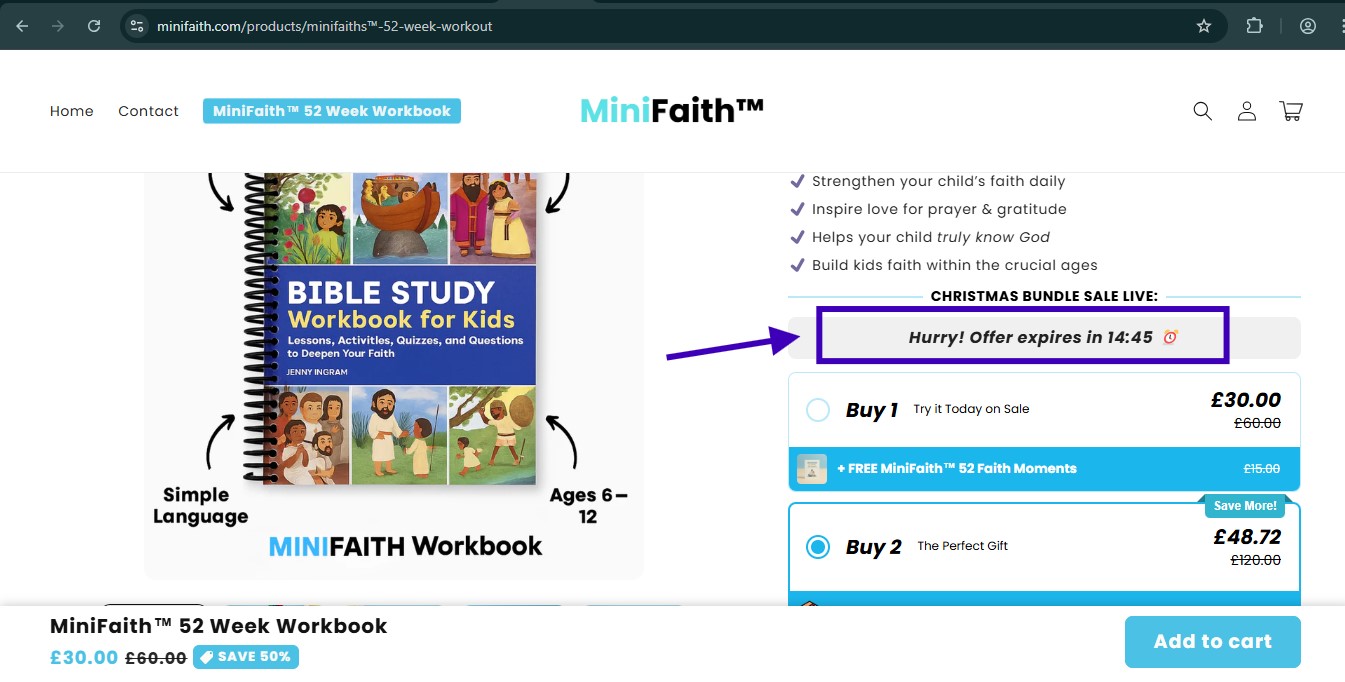
This is the biggest giveaway. When I landed on the product page, banner at the top screamed: “Hurry! Offer expires in 14:45”.
I sat and watched the timer tick down…. When it hit zero, do you know what happened? It simply reset to 15:00 then the count down started again.
This is Fake Scarcity. There is no limited-time offer. The “sale” price of £30 is the permanent price. The timer exists solely to make you panic-buy without doing your research. A ministry focused on truth should not start its relationship with you by lying about a discount timer.
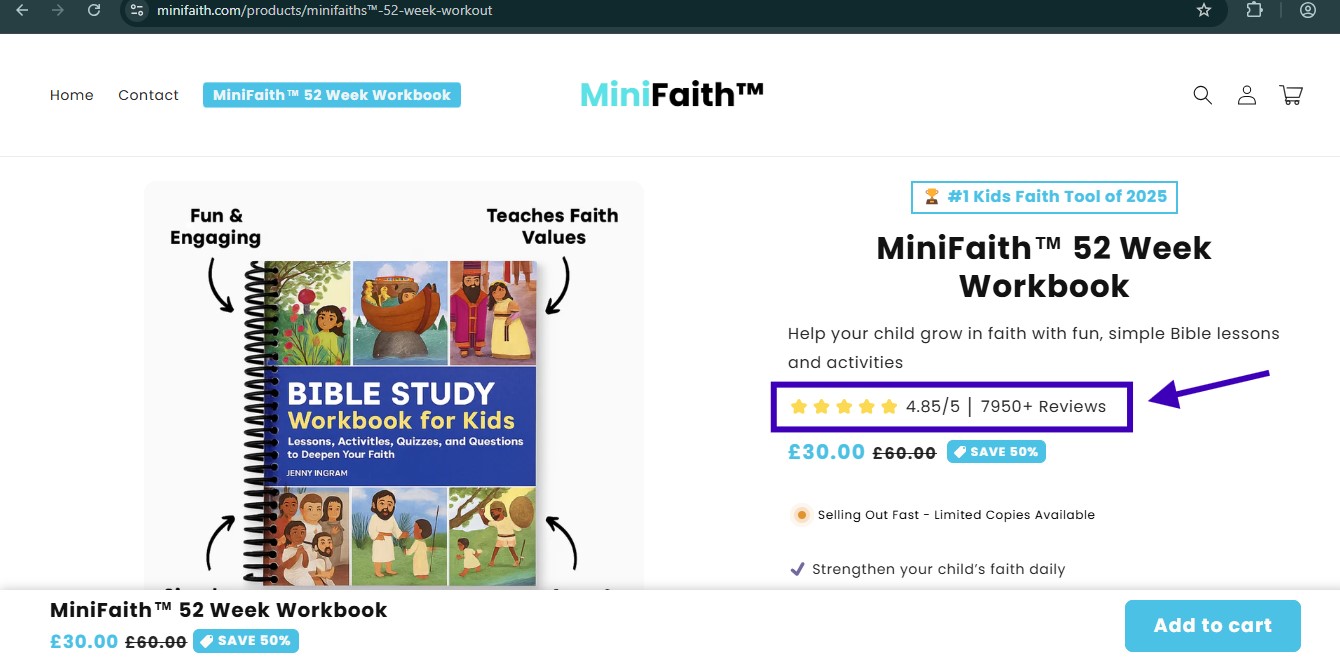
The product page boasts “7950+ Reviews” with a near-perfect 4.85/5 rating.
Let’s look at the numbers. For a niche religious product to have nearly 8,000 reviews, it would need to be selling hundreds of thousands of copies — numbers that rival bestsellers on Amazon.
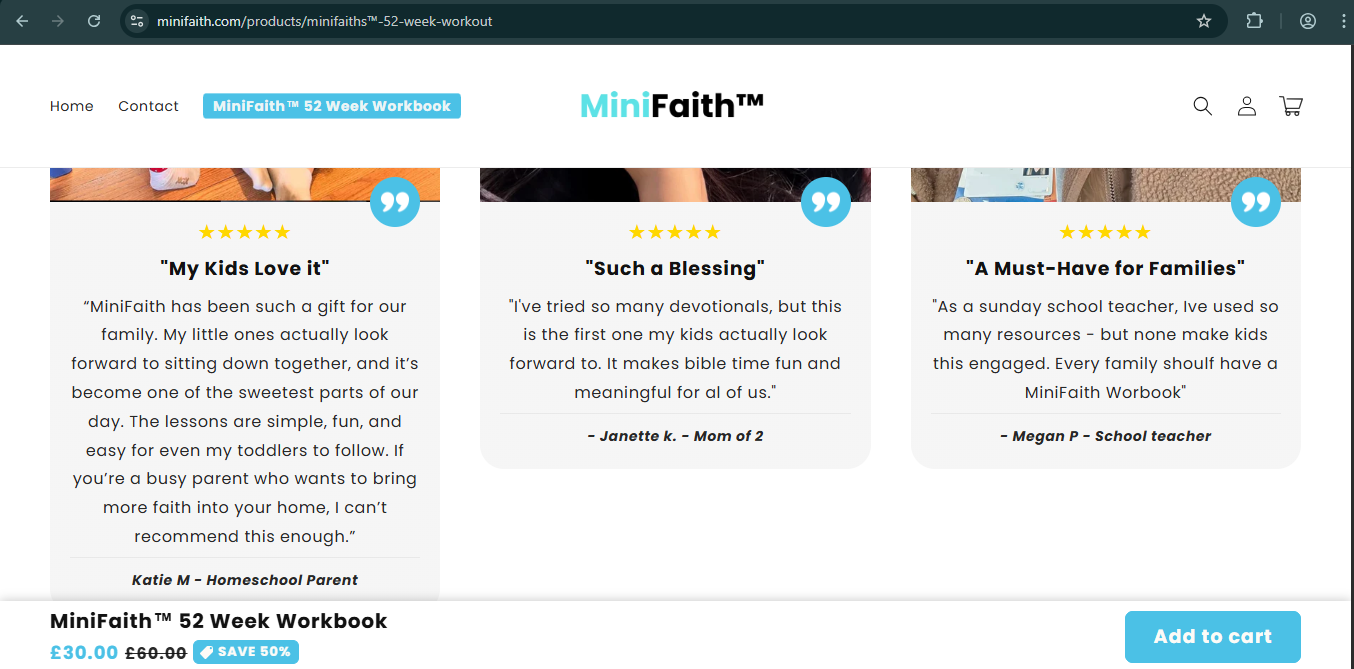
When you look closer at the reviews, they follow a generic pattern. “Janette K” says it’s “Life changing.” “Katie M” says “My kids love it.” The photos attached to the reviews often look professionally lit or oddly generic, lacking the messy reality of a real kitchen table. In the e-commerce world, it is common practice to import reviews from other products or simply fabricate them to build “social proof.”
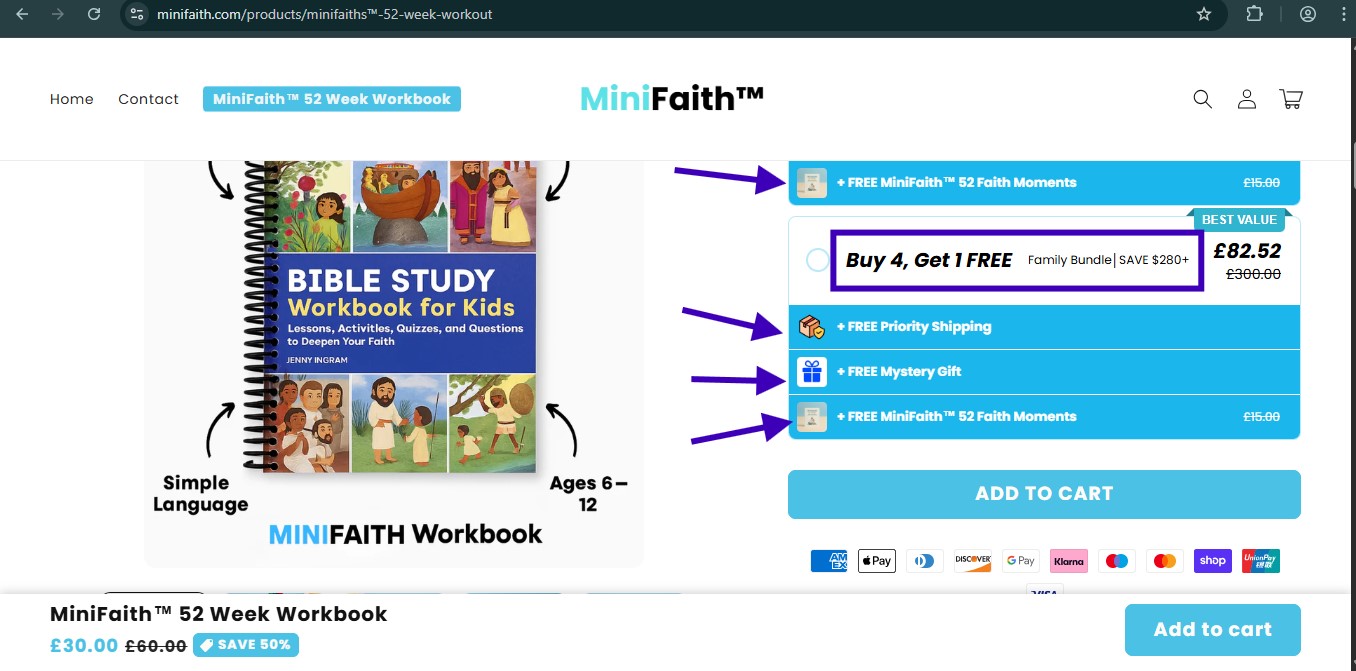
Once you decide to buy one workbook, the site pushes you hard to buy more. There are “Christmas Bundles,” “Family Packs,” and “Buy 4, Get 1 Free” offers.
A standard publisher might offer a small discount for bulk orders, but this aggressive push to increase your “Average Order Value” (AOV) is a hallmark of high-pressure dropshipping funnels. They know that once they have your credit card details, you are more likely to add “just one more” item if they frame it as a deal.
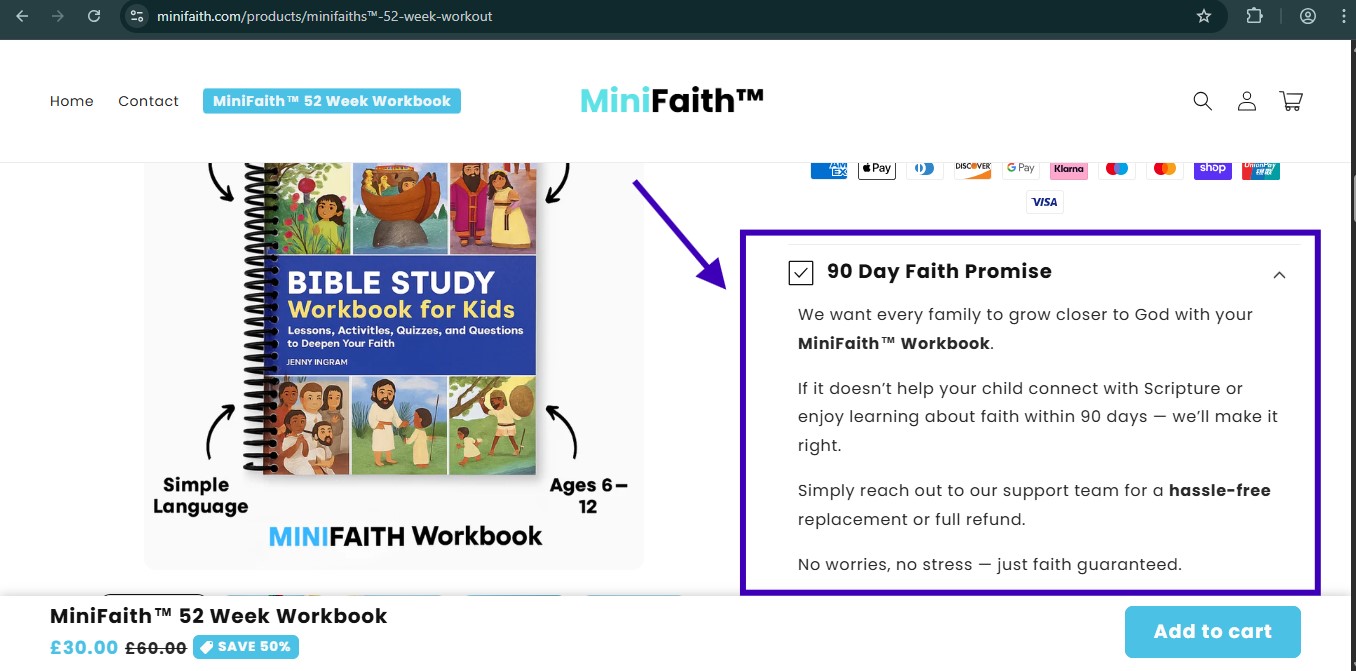
They offer a “90 Day Faith Promise” money-back guarantee. While this sounds generous, dropshipping sites often make the return process incredibly difficult. You may find that you have to pay for shipping back to a warehouse in Shenzhen, China, which costs more than the book itself. Always check the return policy fine print before trusting a “satisfaction guarantee” from a social media ad.
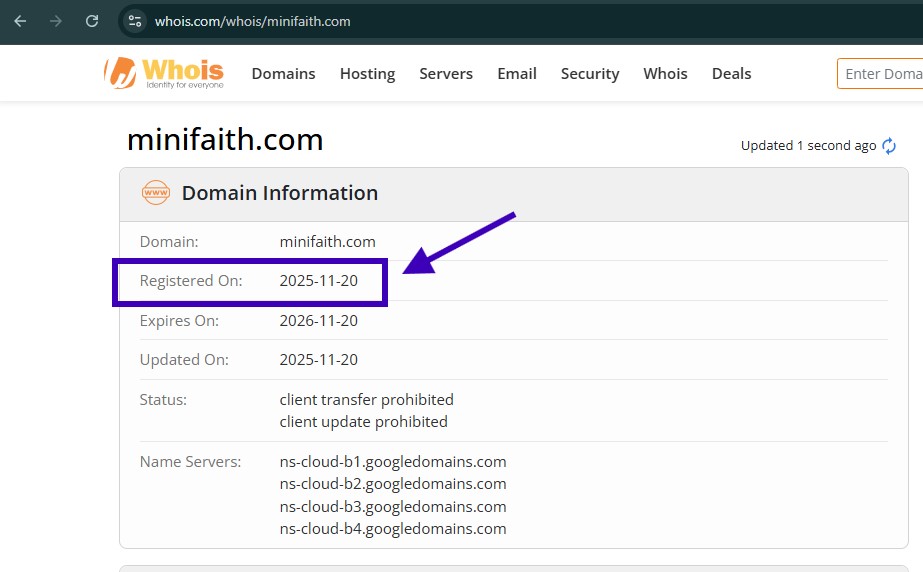
I ran a Whois lookup on the domain minifaith.com. It was registered on November 20, 2025.
As of writing this review (December 15, 2025), the site is less than a month old. Yet, it claims to be the “#1 Faith Tool of 2025” and displays over 7,950 reviews. It is mathematically impossible to generate nearly 8,000 verified reviews in under four weeks. This confirms the reviews are fabricated.
The Content Reality
Let’s put the marketing aside and look at the actual product. Is the content worth the premium price tag?
I analyzed the sample page provided on the site, which focused on the story of Noah’s Ark.
The Activity: A simple word search with words like “ARK,” “ANIMALS,” and “RAIN.”
The Lesson: A three-sentence summary of the Noah story that you could find in any free children’s Bible app.
The Engagement: A “fill in the blank” section that asks very basic comprehension questions.
To be blunt: This is thin.
There is nothing wrong with simple activities, but you are paying £30 (plus shipping) for content that is arguably less substantial than a £5 coloring book you can grab at the supermarket.
The artwork is generic vector clip art — the kind you can license for pennies online. It lacks the warmth and theological depth of resources created by established Christian publishers like Crossway, The Good Book Company, or Zondervan.
There is no author biography listed on the site. We don’t know who wrote the devotionals. Are they a pastor? A theologian? A Sunday school teacher? Or was the text generated by a copywriter (or AI) to fill space between the puzzles? In Christian publishing, knowing the author’s background matters because you are entrusting them with your child’s spiritual formation. The lack of an author bio is a significant Red Flag.
Better Alternative
You don’t need to spend £30 on a viral Instagram product to teach your kids about Jesus. There are incredible, author-verified, and affordable resources available right now.
If you are looking for deep, engaging, and biblically sound workbooks, consider this alternative that cost a fraction of the price.
The Standard Sunday School Workbooks: You can find “The Big Book of Bible Activities” or similar titles on Amazon. They offer hundreds of pages of dot-to-dots, word searches, and mazes — essentially the same content as MiniFaith, but you get 200 pages instead of 52 for a third of the cost.
The creators of MiniFaith have identified a very real problem: Parents are desperate for tools to help their children own their faith. That desire in you is good. It is Holy Spirit-led.
However, MiniFaith is exploiting that desire with high-pressure sales tactics that have no place in ministry. The fake countdown timers, the inflated review counts, and the overpriced, generic content suggest this is a business venture first and a ministry second (if at all).
My Verdict:
Is it a Scam? Yes. Claiming 8,000 reviews for a website that didn’t exist a month ago is fraudulent advertising.
Is it a Rip-off? Absolutely.
Do not let the fear of your child “walking away” drive you to make panic purchases. Spiritual formation happens in the quiet, consistent moments — reading scripture together, praying at bedtime, and living out your faith. You don’t need a £30 “viral” workbook to do that.
Save your money. Buy a reputable devotional from a trusted author, and take your family out for ice cream with the savings.
Join the Community
Subscribe for alerts on new scams and real opportunities.
Have you been scammed?
If you have lost money or suspect a website is fake, report it to us immediately to warn others.
I’m Yhang Mhany, a Ghanaian web developer, and blogger with over five years in the tech industry. I investigate online platforms to separate the scams from the real opportunities. My mission is to build EarnMoreCashToday into the world's #1 Anti-Scam Platform and save humanity from digital fraud.
Thank you very much Mr Mhany. I believe I have fallen for their trap, as I ordered 3 workbooks for my children a few weeks ago and I must admit I have reservations when ordering at their marketing. This is a classic example of why you should trust your gut!
Thank you very much Mr Mhany. I believe I have fallen for their trap, as I ordered 3 workbooks for my children a few weeks ago and I must admit I have reservations when ordering at their marketing. This is a classic example of why you should trust your gut!


 Click to Zoom

 Click to Zoom


Thank you very much Mr Mhany. I believe I have fallen for their trap, as I ordered 3 workbooks for my children a few weeks ago and I must admit I have reservations when ordering at their marketing. This is a classic example of why you should trust your gut!