
Can You Get Money Back From a Scammer? The Hard Truth

 Click to Zoom
When you realize you’ve been scammed, the immediate, sickening feeling of loss is quickly followed by one urgent question: “Can I get my money back?”
The unfortunate and direct answer is rarely, but not impossibly. For the vast majority of scams, the money is gone for good. Scammers design their schemes to be irreversible, relying on speed, anonymity, and payment methods that are nearly impossible to trace or recall.
Your chances of recovering funds depend almost entirely on two factors: the payment method you used and how quickly you realized the scam.
Why Is It So Hard to Recover Money from Scammers?
Scammers are professionals whose entire operation is built around defeating recovery efforts. They don’t keep stolen funds in a traceable bank account. The moment they receive your money, they begin a rapid process to launder it.
This often involves:
- Speed: The money is moved multiple times within minutes, often across different banks, payment apps, or into cryptocurrency.
- Anonymity: They use fake names, stolen identities, and disposable contact information.
- Irreversible Payments: They specifically request payment methods that function like digital cash—once sent, it cannot be taken back.
- International Borders: Many scam operations are based overseas, placing them outside the jurisdiction of local law enforcement and making recovery legally and logistically complex.
Click to Zoom
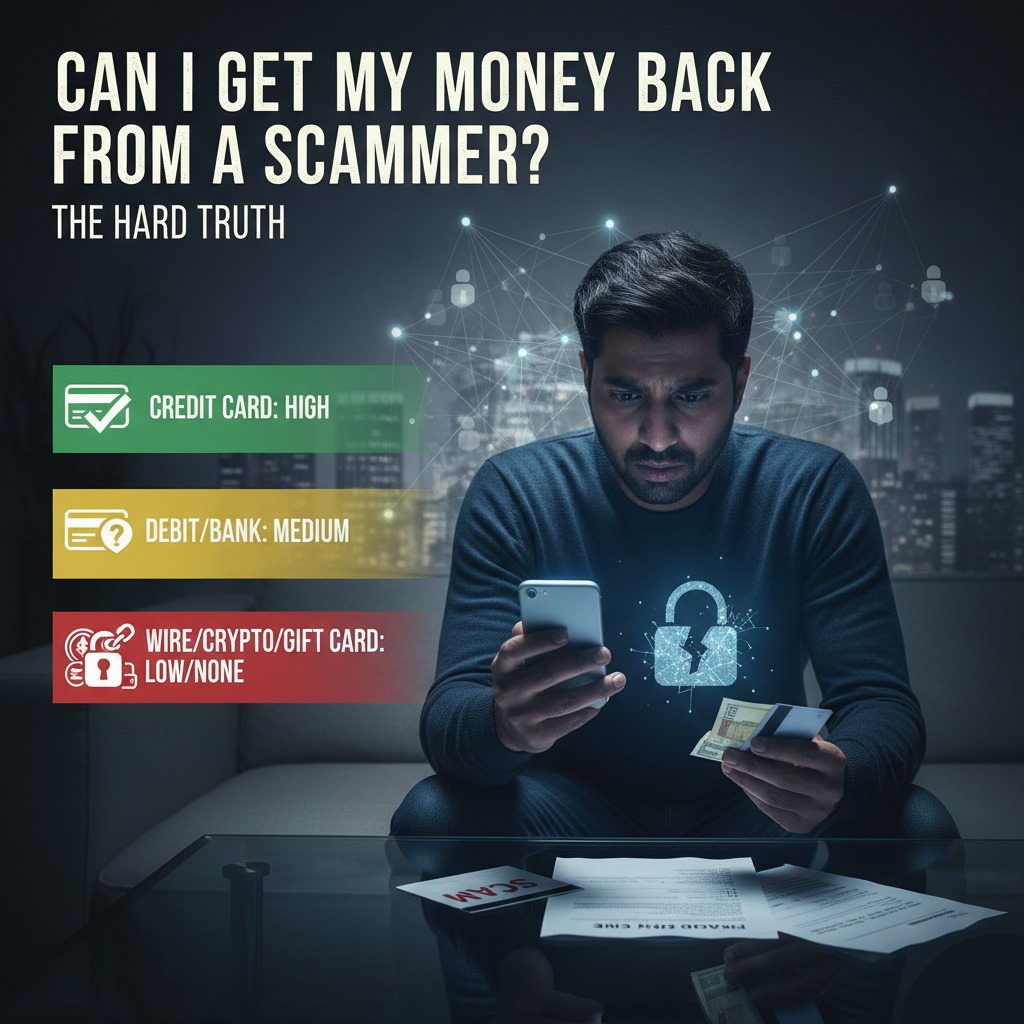
The Deciding Factor: Your Payment Method
The single biggest element determining your chances of a refund is how you paid.
- Credit Cards: This is the only payment method with strong, built-in consumer protection. The concept of a “chargeback” allows your card issuer to reverse a fraudulent transaction. Because of federal laws, your liability for fraudulent charges is typically limited, and banks are highly motivated to investigate.
- Debit Cards & Bank Transfers: These are far riskier. The money comes directly from your account. While some federal protections exist (like Regulation E), they are most effective if you report the fraud immediately (within a day or two). The longer you wait, the less likely the bank can intercept or recover the funds.
- P2P Payment Apps (Zelle, Venmo, Cash App): These apps are a major challenge. Their policies often distinguish between “unauthorized fraud” (someone hacked your account) and “authorized” (you were tricked into sending the money). In the second case, which applies to most scams, apps are often reluctant to provide refunds.
- Wire Transfers, Gift Cards & Cryptocurrency: From a recovery standpoint, these are the worst-case scenarios. They are designed to be untraceable and irreversible. Once the money is sent or the gift card number is shared, it is considered the same as handing someone physical cash. The chances of getting it back are near zero.
The Role of Banks and Law Enforcement
Victims often turn to their bank or the police, expecting them to retrieve the money. It’s important to understand their roles.
- Banks & Financial Institutions: Their fraud departments will investigate, but their power is limited. They can attempt to stop a transfer in progress or reverse a credit card charge. They cannot, however, pull back money that a scammer has already withdrawn or moved.
- Law Enforcement: Filing a police report is crucial for creating an official record of the crime. This report is evidence for your bank and for federal agencies. However, local police departments do not have the resources to track down individual, often international, scammers to recover funds. Their focus is on investigation, not financial retrieval.
- Federal Agencies (FTC, FBI): Reporting to agencies like the Federal Trade Commission (FTC) and the FBI’s Internet Crime Complaint Center (IC3) is vital. While they won’t recover your individual loss, the data they collect is essential for tracking scam networks, identifying patterns, and building larger cases that can shut down entire operations.
The “Recovery Scam”: A Final Warning
In their desperate search for help, many victims are scammed a second time. Scammers, or even new “vultures,” will find victims online and pose as “fraud recovery specialists,” “blockchain investigators,” or “hackers” who promise to get your money back for an upfront fee.
This is always a scam. They are preying on your hope. They will take your “fee” and disappear, compounding the initial loss.
Recommended Articles


The Realistic Outlook
So, can you get your money back from a scammer? While the answer is a painful “probably not,” the exception lies almost entirely with credit card transactions and, in some rare cases, immediate reporting of fraudulent bank transfers.
For most victims, the focus must unfortunately shift from recovery to protection: locking down your accounts, changing passwords, freezing your credit to prevent identity theft, and reporting the crime to help protect others.
Subscribe for alerts on new scams and real opportunities.
Have you been scammed?
If you have lost money or suspect a website is fake, report it to us immediately to warn others.
REPORT A SCAM NOW