
How to Verify Any Loan App in Ghana: BoG Approved List

 Click to Zoom
Nearly every predatory loan app in Ghana relies on one bet: that you will tap Install in a financial emergency before checking whether the company legally exists on the Bank of Ghana register. Once an unlicensed app harvests your Ghana Card photo, contacts, and call logs, you are no longer dealing with a lender. You are handing extortion material to an unregulated syndication network.
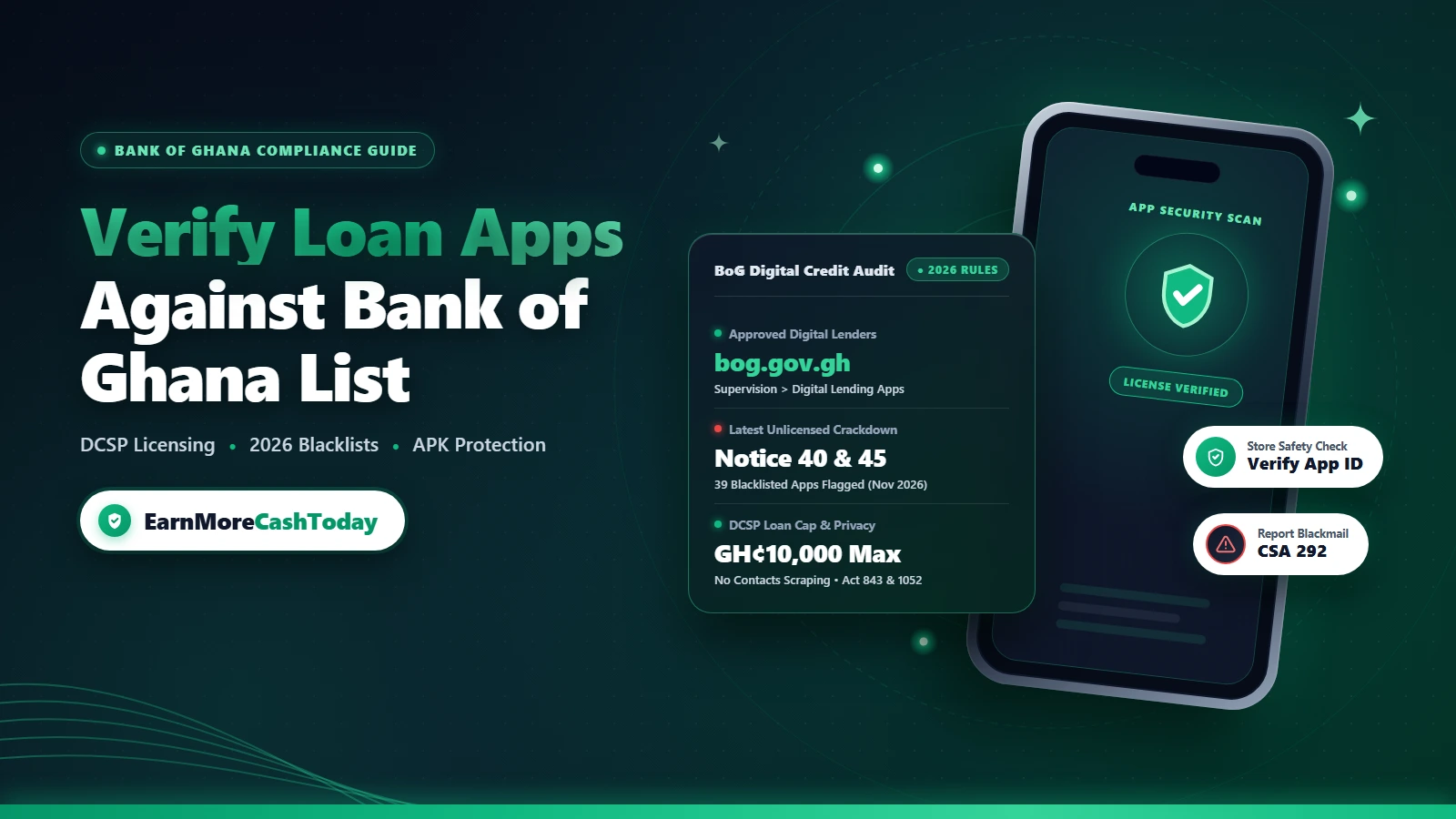
To verify any loan app in Ghana, visit bog.gov.gh, select Supervision & Regulation > All Institutions, and confirm the exact corporate name and app appear under Digital Lending Applications, Approved Digital Credit Products and Applications, or licensed bank and Tier 3 microcredit lists. Cross-check recent Bank of Ghana blacklists including Notice No. BG/GOV/SEC/2026/45 before downloading.
Why Unlicensed Ghana Loan Apps Still Slip Onto Your Phone
Many borrowers assume any finance app listed on the Google Play Store or promoted in a Facebook reel carries central bank backing. That assumption costs Ghanaians millions of cedis in illegal fees and extortion payments every year.
Google enforces global rules prohibiting personal loan apps from demanding repayment in 60 days or less, requiring upfront maximum APR disclosures, and blocking access to sensitive Android permissions such as Contacts (READ_CONTACTS), Photos and Videos (READ_MEDIA_IMAGES, READ_MEDIA_VIDEO, READ_EXTERNAL_STORAGE), Call Logs, and Precise Location (ACCESS_FINE_LOCATION).
To evade those guardrails, rogue operators use two workarounds:
- Sideloaded .apk Links: Scammers run social ads or WhatsApp broadcasts urging you to download an Android package file directly from a browser link, bypassing Play Store permission screening entirely.
- Shell App Rotation: When the Bank of Ghana (BoG) and Cyber Security Authority (CSA) flag an unauthorized app, operators abandon that listing and push a nearly identical clone under a fresh developer account within days.
Before trusting any digital lender promising instant cash, compare it against our curated directory of verified loan options rather than clicking sponsored social ads.
How Legal Digital Credit Works Under Bank of Ghana Law
On November 1, 2025, the Bank of Ghana brought into force its Directive for Digital Credit Services Providers in Ghana (issued in September 2025 under the Non-Bank Financial Institutions Act, 2008, Act 774), opening licensing applications via its Online Regulatory Analytics Surveillance System (ORASS) on November 3, 2025. Existing unlicensed digital lenders were given a transition deadline that expired on June 30, 2026.
A standalone Digital Credit Services Provider (DCSP) cannot operate from an anonymous laptop or offshore shell. Under the BoG directive, a licensed DCSP must meet strict structural hurdles:
- Capital & Loan Caps: At least GH¢2,000,000 in minimum paid-up capital, a maximum gearing ratio of 8, and a hard ceiling of GH¢10,000 per individual digital loan.
- Licensing Fees: GH¢10,000 processing fee, GH¢20,000 licensing fee, and GH¢10,000 renewal fee every 2 years.
- Local Ownership & Office: Minimum 30% Ghanaian equity participation, a 90% cap on any single shareholder, and a verifiable physical office address in Ghana to handle borrower complaints within a maximum 20-day turnaround.
- Activity Firewall: A standalone DCSP is barred from taking customer deposits, dealing foreign exchange, or operating general payment services.
However, not every legal loan app uses the standalone DCSP license. Ghana’s authorized digital loans actually sit across four distinct Bank of Ghana regulatory tracks, which is why borrowers get confused during verification.
| BoG Regulatory Track | Governing Law / Oversight | How Digital Loans Reach Borrowers | Verified Ghana Examples |
| Universal Banks (Class I) | Banks and Specialised Deposit-Taking Institutions Act, 2016 (Act 930) | Direct bank mobile apps and approved digital credit products | Absa Bank Ghana, Ecobank Ghana, CalBank, CBG, Fidelity Bank, First Atlantic Bank |
| Savings & Loans / Tier 2 & 3 Micro-Credit | Act 930 / NBFI Act, 2008 (Act 774) | Standalone licensed lending apps or bank-telco credit partnerships | Fido Micro Credit Limited (com.fido.ghana), Letshego Ghana Savings and Loans PLC |
| Telco & FinTech Rails (DEMI / PFTSP) | Payment Systems and Services Act, 2019 (Act 987) | USSD mobile money loans underwritten by licensed banks or S&Ls | MTN MoMo QwikLoan (*170#, Letshego + JUMO Ghana Ltd), Telecel Cash Ready Loan (*110#, CBG) |
| Digital Credit Services Providers (DCSP) | Act 774 & Sept 2025 BoG Digital Credit Directive | Digital-only micro-loans capped at GH¢10,000 per loan | Registered entities verified on bog.gov.gh FinTech & Supervision registers |
Notice how partnership loans work behind the scenes. When you dial *170# for MTN MoMo QwikLoan, MTN Ghana provides the wallet distribution rail, JUMO Ghana Limited (registered with the BoG as a Payment Service, Finance, Technology and Services Provider, or PFTSP) handles credit scoring infrastructure, and BoG-licensed Letshego Ghana Savings and Loans PLC underwrites the credit. Similarly, Telecel Cash Ready Loan on *110# is underwritten by Consolidated Bank Ghana Limited (CBG).
For a deeper breakdown of licensed lending channels and borrowing requirements, review our guide to securing a legitimate loan in Ghana.
Check Any Loan App Before You Apply
Run these five checks in order before typing your Ghana Card number, Mobile Money number, or bank details into any lending platform.
Step 1: Audit the Official Bank of Ghana Registers
Never rely on a badge or certificate image pasted inside an app’s promotional graphic. Criminals forge PDF letters and slap the Bank of Ghana crest onto unauthorized apps.
- Visit www.bog.gov.gh directly in your browser.
- Open Supervision & Regulation > All Institutions and inspect both Digital Lending Applications and Approved Digital Credit Products and Applications.
- If the app claims backing from a bank, savings and loans company, or Tier 3 micro-credit company (like Fido Micro Credit Limited), search the underlying legal entity name under Banks, Savings and Loans Companies, or Microfinance / Micro-Credit Institutions.
- Also check FinTech & Innovation > Approved Institutions (bog.gov.gh/fintech-innovation/approved-institutions/) to confirm any named payment partner (DEMI, PSP, or PFTSP) actually holds an active license under Act 987.
Step 2: Scan Recent Bank of Ghana Unlicensed Blacklist Notices
Because the post-June 30, 2026 enforcement wave moves quickly, an app that was unknown last month may already be blacklisted this week. Click the Notices section on bog.gov.gh and check the latest releases from the FinTech and Innovation Office and Cyber Security Authority.
For example, in Notice No. BG/GOV/SEC/2026/40 (issued November 2, 2026), the Bank of Ghana flagged 20 unlicensed apps: Active Loan, Boafo Cash, Cediln, Fair Moni, Fast Loan, Halo Loan, Jmoney, Kredi, KudiNow, LendJet, MeCedi, NhyiraCash, Palcash, Quick Eazzy, SikaFlow, SikaNea, Swift Lending, TrustCredit GH, Velzo, and Zedvance.
Just fifteen days later, Notice No. BG/GOV/SEC/2026/45 (published November 17, 2026) blacklisted another 19 unlicensed apps: Cedi Trust, CediCredit, Codo, Easy Moni, EasyRate Loan, Focus Loan, Gaga Credit, Hold Cash, Hope Funds, Mondi Money, Monifi, Pulse Cash, Quick Loan (Easy Cash Loan), Score Cash, Sika Bosea, Sika Prime, SikaPadi, SmoothCash, and SoarCredit.
Keep an eye on our continuously updated tracker of illegal loan apps in Ghana whenever new central bank notices drop.
Step 3: Verify the Exact Google Play Package ID and Developer Entity
Fake loan apps copy the names and logos of licensed lenders like Fido or Ghanaian commercial banks. Open the app listing on Google Play, tap About this app, scroll to App info, and verify both the developer entity and the exact package ID in the store URL.
For example, the authentic Fido app carries the Google Play package ID com.fido.ghana under developer Fido Finance Ghana Limited (Fido Micro Credit Limited). If an app claims to be Fido or a major Ghanaian bank yet lists a generic Gmail developer address, mismatched package ID, or a newly created foreign LLC with zero verifiable Accra office address, abort immediately.
Step 4: Inspect Android Permissions Before Signing In
Tap App permissions (or watch the first-launch permission prompts) before creating an account. Under Act 843 (Data Protection Act, 2012) and Google Play personal loan policy, a genuine credit app has zero legitimate reason to read your family phonebook or private gallery.
Reject and uninstall any loan app demanding access to:
- Contacts (READ_CONTACTS)
- Photos, Videos, or Shared Storage (READ_MEDIA_IMAGES, READ_MEDIA_VIDEO, READ_EXTERNAL_STORAGE)
- Call Logs
- Unrestricted Accessibility Services (BIND_ACCESSIBILITY_SERVICE)
Step 5: Demand an Act 1052 Pre-Agreement Disclosure and Annualized Rate
Under the Borrowers and Lenders Act, 2020 (Act 1052), regulated lenders cannot spring surprise fees after disbursement. Lenders must hand you a Pre-Agreement Disclosure Statement (First Schedule of Act 1052) before you accept the loan, and Section 55(2) mandates that interest rates be calculated strictly on an annual basis, banning deceptive monthly rate advertising.
When evaluating a real commercial bank loan before signing, plug the principal, tenure, and stated rate into our Ecobank loan fee calculator to confirm what the total annual repayment actually costs.
Hidden Traps and Edge Cases Where Borrowers Still Get Burned
Even cautious borrowers who avoid obvious scam texts get trapped by five deceptive mechanics in Ghana’s digital credit market.
1. The 7-Day Fee Deduction Math Trap
Illegal loan apps advertise harmless-sounding rates like 0.1% daily interest while stripping huge upfront processing deductions out of your disbursement. Consider how the math actually works on a GH¢500 7-day nano-loan:
If an app deducts a GH¢150 service charge upfront, you receive only GH¢350 in Mobile Money while owing GH¢535 seven days later. You are paying GH¢185 in borrowing cost for one week on GH¢350 of usable cash (52.86% in 7 days). Annualized over 365 days, that equals 2,756% APR, before daily default penalties start compounding.
2. Unsolicited MoMo Loan Deposits
Scammers abuse leaked Ghana Card numbers and phone records from unrelated data breaches to push GH¢100 to GH¢300 into your Mobile Money wallet without your consent. Hours or days later, collectors call demanding double repayment under threat of blasting your contacts as a defaulter. Never spend unexpected MoMo inflows from unknown merchant IDs, and do not return funds to private personal numbers provided over phone calls.
3. The National Credit Bureau Blacklisting Bluff
Rogue collectors routinely send fake legal notices threatening to blacklist you at XDS Data or MyCreditScore or procure an immediate police arrest warrant unless you pay within two hours. Under the Credit Reporting Act, 2007 (Act 726), only Bank of Ghana-licensed institutions can submit credit data to authorized Credit Reference Bureaus (CRBs). Unlicensed apps have zero API access to XDS Data or MyCreditScore, and operating without a central bank license strips them of legal standing to sue you in a Ghanaian court.
4. Upfront Insurance or Activation Fee MoMo Scams
A separate fraud ring operates fake WhatsApp and TikTok pages mimicking licensed lenders or government business grants, instructing applicants to send GH¢80 to GH¢400 upfront via MoMo as an activation deposit, clearance fee, or loan insurance before disbursement. No Bank of Ghana-licensed lender asks you to send Mobile Money upfront to release or insure a loan. Legitimate fees are either disclosed under Act 1052 and netted out transparently or built into scheduled repayments.
5. Abusive Debt Shaming Even After Full Repayment
Borrowers who panic and pay off an illegal loan app often discover the collectors demand a second phantom penalty fee, claiming the MoMo confirmation did not reflect before the afternoon cutoff. Because the collectors already copied your contact list and Ghana Card selfie during onboarding, paying them once does not delete your stolen dataset.
| Risk Signal | BoG-Licensed Digital Lender | Illegal / Rogue Loan App |
| BoG Register Status | Listed on bog.gov.gh Supervision or FinTech register | Missing from BoG register or named in Notice BG/GOV/SEC/2026/40 or 45 |
| Distribution Channel | Official Google Play / Apple App Store or verified USSD (*170#, *110#) | WhatsApp .apk links, cloned Play Store shell apps, or Telegram groups |
| Repayment Tenure | Clear multi-week or multi-month schedules (60+ days on Play Store) | Forced 7-day or 14-day repayment traps with instant daily penalties |
| Interest & Fee Quote | Pre-Agreement Disclosure Statement with annual rate per Act 1052 | Deducts 25% to 40% upfront and hides true 1,000%+ annualized APR |
| Device Permissions | Minimal KYC permissions; no contact or gallery scraping | Demands Contacts, Photos/Media, and Call Logs for debt shaming |
| Default Recovery | Formal reminders, Act 726 credit reporting, and lawful process | Contact-list blasting, defamatory flyers, and fake arrest threats |
Concrete Action and Recourse Plan Before and After Compromise
Whether you are checking a lender right now or already trapped in contact-shaming extortion, follow this exact enforcement protocol.
Before You Borrow: Lock Your Digital Footprint
- Verify Both Entity and Channel: Confirm the lender’s legal name on bog.gov.gh, check recent BG/GOV/SEC blacklist notices, and confirm the developer name and package ID inside the app store.
- Use Regulated Mobile Money USSD Menus First: Need emergency small credit? Stick to regulated telco-bank menus such as MTN MoMo QwikLoan (*170# -> Financial Services -> Loans) or Telecel Cash Ready Loan (*110#), or apply directly through a BoG-licensed commercial bank app.
- Never Pay Upfront MoMo Fees: Close the chat immediately if anyone requests a deposit, Ghana Card processing fee, or tax clearance via personal MoMo before releasing a loan.
First 15 Minutes If You Installed a Rogue Loan App
- Cut Network and Revoke Permissions Immediately: Open Android Settings > Apps, select the rogue loan app, and revoke Contacts, Photos and videos / Storage, Call logs, Camera, and Location immediately before uninstalling the app. If it was sideloaded as an .apk file or granted Accessibility permissions, switch on Airplane Mode, uninstall it, or factory reset your phone.
- Preserve Forensic Evidence: Take full screenshots of the app store listing, package URL, payment receipts, MoMo merchant names used for transfers, and every threatening SMS or WhatsApp message (including sender phone numbers).
- Pre-Empt Contact Shaming: Send one short broadcast note to key family members, workplace contacts, and close friends explaining that an illegal loan app scraped your address book and that any defamatory flyer or scam message using your photo should be ignored and blocked.
- Stop Paying Extortion Demands: If you already repaid the original principal received (or received an unsolicited deposit) and collectors keep fabricating new penalties, stop sending money to personal MoMo accounts.
Escalate to Ghana’s Cyber, Privacy, and Banking Regulators
File formal complaints with your evidence bundle across these official Ghanaian authorities:
- Cyber Security Authority (CSA Ghana): Call or SMS 292, message WhatsApp 0501603111, email report@csa.gov.gh, or submit through the CSA GHANA mobile app for cyberbullying, extortion, and digital blackmail under the Cybersecurity Act, 2020 (Act 1038).
- Data Protection Commission (DPC): Call +233 256 301 533 (general inquiries) or 0256302031 (compliance), message WhatsApp 0506177975, or email info@dpc.gov.gh (dpc.gov.gh) to report unauthorized contact scraping and defamation under the Data Protection Act, 2012 (Act 843).
- Bank of Ghana FinTech & Complaints Desks: Report unlicensed digital lenders to the FinTech and Innovation Office via fintech@bog.gov.gh or digitalcredit@bog.gov.gh. For disputes involving licensed banks, microcredit firms, or payment providers handling transactions, contact the Financial Stability Department Complaints Management Office on 0593974486 (phone or WhatsApp) or complaints.office@bog.gov.gh (P. O. Box GP 2674, Accra).
- Law Enforcement (EOCO & Ghana Police Cyber Crime Unit): For organized financial extortion or identity fraud, contact EOCO (0800 911 911, 0308 043 621, 0547 419 419, WhatsApp 0579709066, eoco@eoco.gov.gh) or the Ghana Police Service Cyber Crime Unit (18555 or 191).
Frequently Asked Questions
How do I check if a loan app is approved by the Bank of Ghana?
Visit bog.gov.gh, open Supervision & Regulation, select All Institutions, and review Digital Lending Applications plus Approved Digital Credit Products and Applications. You can also check Banks, Tier 3 Micro-Credit lists, and FinTech & Innovation Approved Institutions to confirm the parent company and verify recent BG/GOV/SEC blacklist notices.
Which loan apps are licensed by the Bank of Ghana right now?
Verified digital credit options include Bank of Ghana-licensed universal bank apps such as Absa Bank Ghana, Ecobank Ghana, CalBank, CBG, Fidelity Bank, and First Atlantic Bank, Tier 3 micro-credit lender Fido Micro Credit Limited, and regulated telco-bank products like MTN MoMo QwikLoan (Letshego and JUMO) and Telecel Cash Ready Loan (CBG).
Can an unlicensed Ghana loan app put me on XDS Data or MyCreditScore?
No. Under the Credit Reporting Act, 2007 (Act 726), only Bank of Ghana-licensed financial institutions and authorized data providers can report defaults to licensed Credit Reference Bureaus like XDS Data or MyCreditScore. Unlicensed loan apps have zero legal access to national credit bureaus and cannot enforce illegal debt contracts in court.
What happens if an illegal loan app messages my contacts in Ghana?
Sending automated defamatory messages or edited photos to your contacts violates the Data Protection Act, 2012 (Act 843) and Cybersecurity Act, 2020 (Act 1038). Revoke the app’s Contacts and Storage permissions immediately, screenshot all threats and sender numbers, alert your contacts, and report the extortion to CSA on 292 and DPC at info@dpc.gov.gh.
What is the maximum digital loan a licensed DCSP can offer in Ghana?
Under the Bank of Ghana Directive for Digital Credit Services Providers (effective November 1, 2025), standalone Digital Credit Services Providers are capped at GH¢10,000 per individual digital loan and must hold GH¢2,000,000 in minimum paid-up capital plus a physical Ghanaian office. Larger personal loans require licensed banks, savings and loans companies, or Tier 2/3 institutions.
Subscribe for alerts on new scams and real opportunities.
Have you been scammed?
If you have lost money or suspect a website is fake, report it to us immediately to warn others.
REPORT A SCAM NOW


